


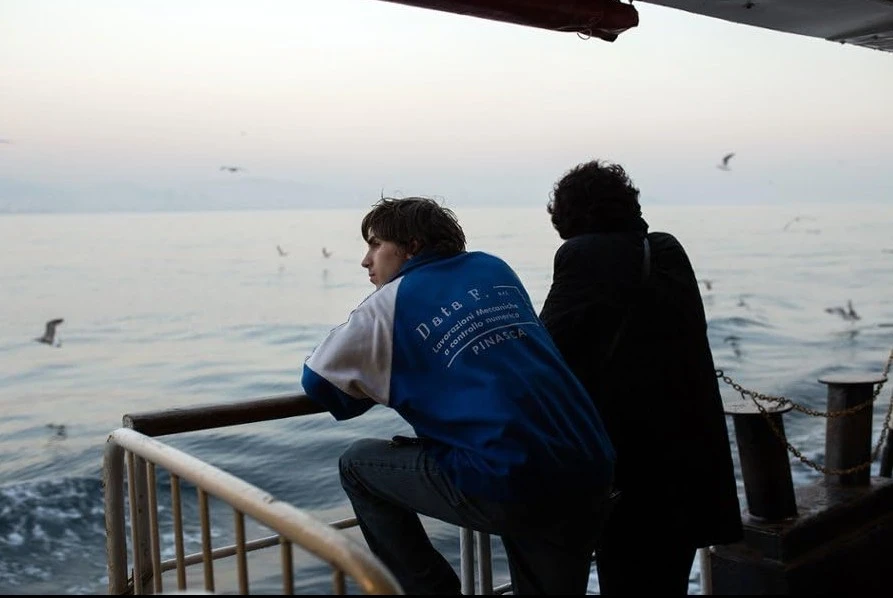
Directed by Levan Akin, Crossing (2024) focuses on three different lives intertwined in a complex structure. Starring Mzia Arabuli (Lia), Lucas Kankava (Achi), and Deniz Dumanlı (Evrim), the film won the Jury Special Award at the Berlin Film Festival.
TR | EN | Türkçe versiyona buradan ulaşabilirsiniz.
Three strangers whose paths cross in Istanbul share a common wish: to find Tekla.
Lia is searching for her niece Tekla, from whom she separated years ago, but cannot find her in Georgia, the country where she lives in. One day she learns that Tekla has moved and decides to go to Istanbul. Achi, who has major problems with his family, offers to help her. Thus, the two set out on a journey. Meanwhile, Evrim (meaning “evolution”), a trans individual living in Istanbul, is trying to complete the official procedures to become a woman.
At the center of this cluster of stories lies an aunt–niece relationship. This is a subject rarely explored in both Turkish and world cinema. Yet this relationship is at least as authentic and deep as that between a mother and child. Indeed, the most striking and memorable part of the story is Lia’s unwavering persistence in searching for her niece. Years ago, she gave up on Tekla solely because she was a trans individual, but upon her sibling’s death, she promised to find her. The image that best conveys her stubbornness in this regard is the high-heeled shoes she wears. At the beginning of the film and at its breaking points, the sound of these heels is heard very clearly. So much so that on the first night, Lia decides to go in search of her niece, she does not take them off even while sleeping.

Searching for Tekla is searching for oneself, and perhaps finding oneself
The metaphor is, in fact, a sign of firm steps and determination. Because the sound of these shoes directly evokes the feeling of “I am here.” At the same time, it is directly related to the concept of womanhood. For instance, Evrim’s shoes are colorful and high-heeled, whereas Lia’s are black with short heels. Both exist, but in different forms.
For example, in one scene, Lia says to Evrim, “I could never wear your shoes.” This is used both literally and metaphorically. Because, as the proverb says, “Before you judge a person, walk a mile in their shoes.” Therefore, this scene also draws attention to the difference between acceptance and approval. Lia is distant toward LGBTQ+ individuals, yet she is ready to accept her niece as she is and to stand by her side as her aunt. Because searching for Tekla is, in fact, the possibility of searching for herself and perhaps finding herself.
Knocking on doors to uncover the past
Having focused on the lives of LGBTQ+ individuals in And Then We Danced (2019), Levan Akin once again addresses the lives of these vulnerable individuals in this film through Evrim. He approaches their lives not as an observer but as a subject, and tells their stories with respect. He expresses their lives honestly. In this sense, it can be said that the film has a feminist narrative and camera language. Especially the emotional transitions Lia experiences while visiting the home of sex workers are conveyed in a very striking way through suffocating colors such as red and green, through Nesimi’s folk song Minnet Eylemem, and through the set design used.
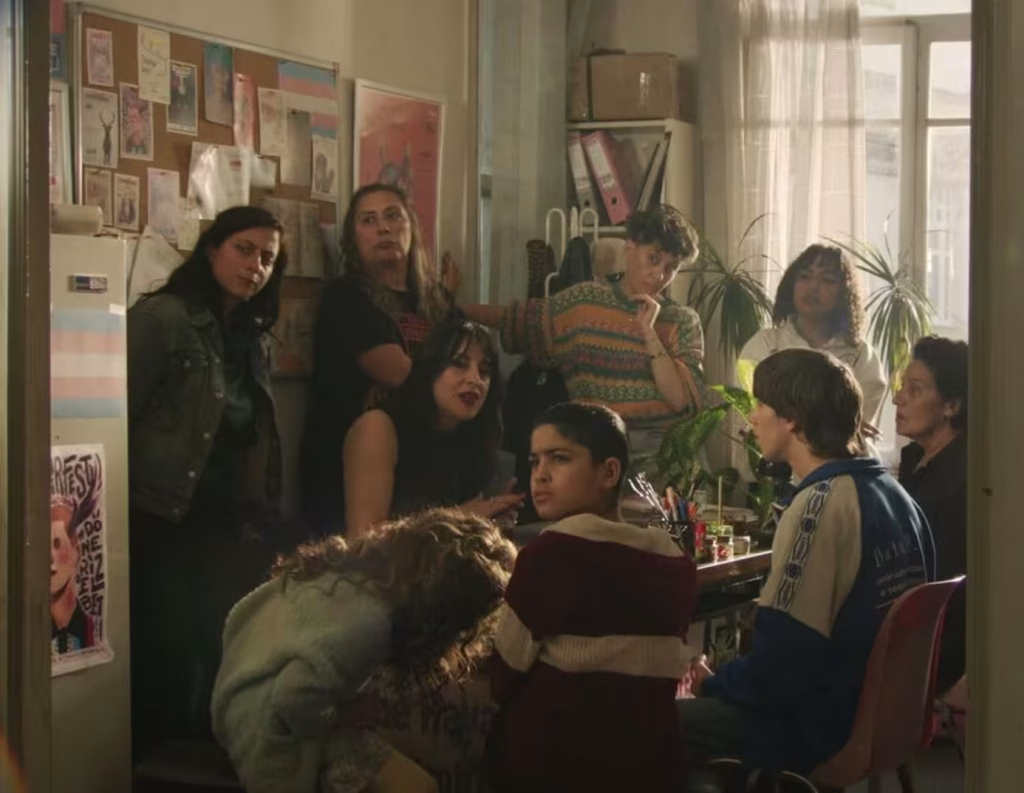
Indeed, thanks to the film’s strong art direction, each space reflects its own inner world very well. These places are most often encountered while searching for the past: Lia’s home, the rooms of the sex workers, and the hotel they stay in are presented to the audience through worn walls, sometimes a simple window, and sometimes old and dilapidated décor, laying bare the situations and states of mind of the characters inhabiting them.
There is another striking detail in the film: its title. The word Crossing is truly used as it deserves to be. This word has two meanings in English: transition and intersection. It fits the story of the film perfectly. Perhaps this is the story of how intersecting paths slowly become connected. A crossing from one country to another, from one gender to another, from one language to another, from one belief to another… Indeed, at the very moment the crossing process first begins, all the characters are transferring on a ferry between the two sides of Istanbul.
The unity of conflicts: A cultural mosaic
The film consists of a whole range of conflicts, such as feminism–patriarchy, power–weakness, and hope–pessimism. The most important of these is the conflict between youth and old age. This is seen especially in the scenes between Lia and Achi. The director wanted to associate this particularly with a metaphor: the instinct to eat. Because the more eagerly Achi eats, the more slowly and unwillingly Lia eats. This is actually a manifestation of hunger for life. Indeed, the fact that Lia is a history teacher also strengthens this argument.

It can be said that the most memorable element of the film is the music used. Music appropriate to the spirit of the emotions experienced, and the places inhabited, is chosen, many of which are almost iconic works reflecting Turkish culture. In this respect, Türkiye is portrayed as a mosaic: Kurdish–Turkish, classical–traditional songs, Sufi music, Arabesque culture…
Thanks to this music and the sound design, Istanbul is treated as a whole. Its traditional architecture, dark streets, spacious sea… The characters are set on a journey with the awareness that a world exists within this city. Because it is, in fact, presented as a fourth character. Indeed, on the film posters, Istanbul is depicted either through its sea or its streets. Its horn noises, crowds, distorted urbanization, and status as a metropolis open to everyone give it truly unique characteristics. At times stifling, breaking, saddening; at other times full of surprises, entertaining, and protective…
The story of those embracing each other in a turbulent world
The film’s main actors, Mzia Arabuli and Lucas Kankava, deliver performances as striking as Istanbul itself. From the very first moment, they achieve an incredible unity with their characters and never let the audience disengage from the story. Their harmony and their sweet–harsh relationship are conveyed to the audience with complete honesty. At this point, one more name stands out and cannot go unmentioned: Bünyamin Değer (İzzet).

First of all, it is necessary to talk about the way this character appears on screen: Lia and Achi board the ferry, but it is so crowded that they begin to be tossed around from one place to another. The camera is carried along by this flow and at a certain point, loses the characters. It passes the stairs, comes to the ferry deck, and finally encounters İzzet. This entire scene is shot in a single take, and Lisabi Fridell’s camera accomplishes a very difficult shot.
Portraying a street child (perhaps it would be more accurate to say a street musician), Değer brings one of Istanbul’s real problems to light through both his musical talent and his seamless performance: orphaned, impoverished children. Akın must truly be taking this issue seriously; it is no coincidence that the person whose path intersects with all the characters in the film is a child. In this sense, children are treated as the film’s soft underbelly but also as its key point.
Crossing (2024) is a work that will remain in memory for a long time with its performances, cinematography, soundtrack, and story. Especially for those who do not give up and insist on being themselves, it will recall fragments of their own lives. Perhaps this is the most unique power of the art of cinema: to remind and to be remembered. Let us end with the film’s final song, Tülay German’s Ne Pleure Pas:
No, do not cry when the sea roars and howls
No, do not cry; beautiful times will come tomorrow

Leave a Reply