


From loneliness and invisibility to surveillance, aging, and human connection, Chinese filmmaker Bo Hanxiong reflects on the deeply personal origins of his award-winning short film No One Knows I Disappeared, the visual language behind it, and why strangers can sometimes understand each other better than family.
Following its world premiere in the Golden Goblet Short Film Competition at the Shanghai International Film Festival, No One Knows I Disappeared continued an impressive festival journey through San Sebastián International Film Festival, Vancouver International Film Festival, and Palm Springs International ShortFest. Most recently, the film received the Golden Cherry Award at the 3rd Koker International Short Film Festival, where we had the opportunity to meet its director, Bo Hanxiong.
Hanxiong discusses how a childhood memory inspired the film, why he deliberately keeps the audience at a distance from Lin, and how No One Knows I Disappeared ultimately became a story about people who quietly disappear while living among us.
TR | Türkçe versiyonunu okuyabilirsiniz.
“The film began with my fear that one day my grandmother would simply disappear.”
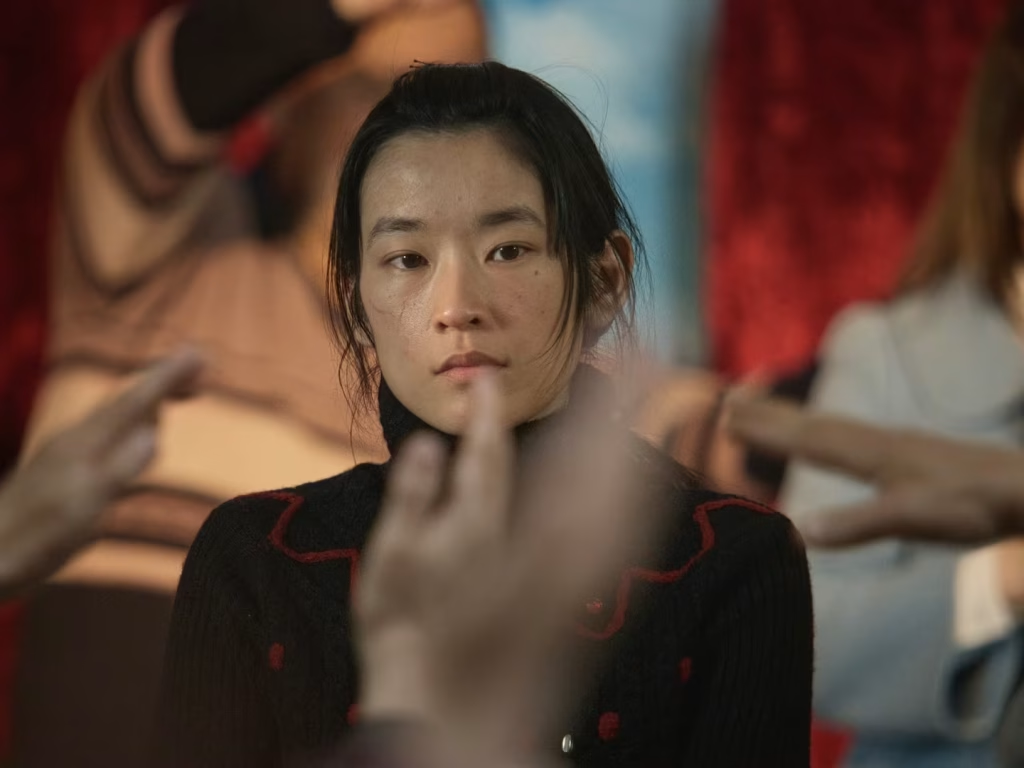
The film feels deeply personal. What was the starting point for No One Knows I Disappeared? What emotion or idea inspired you to tell this story?
Bo Hanxiong: First of all, I’m really glad to hear your interpretation of the film. What you described is very close to what I hoped to express through this story.
The film began with a childhood memory involving my grandmother and the young woman who used to take care of her.
When I was young, my family hired a nanny to look after my grandmother. She came from a small village far away from the city, and she was incredibly young—only seventeen or eighteen years old. Although she had already escaped an abusive marriage and left her child behind to find work in the city, she was still just a teenager.
I vividly remember watching her after she had finished her work. She would simply sit in my grandmother’s yard and play with little stones. Despite everything she had experienced, she still looked like a child.
That image stayed with me for years.
The film was actually shot in my grandmother’s real house and yard, which made those memories even more personal.
As I grew older, I also watched my grandmother become increasingly lonely. Her children cared for her financially, but I often felt that no one truly understood her emotional or spiritual needs. The only companion she really had was her cat, and she spent a great deal of time talking to it.
One thing always fascinated me: when cats grow old, they often leave home and die alone.
For me, that became a metaphor for many elderly people in China. As they grow older, many begin to feel invisible, forgotten, or no longer useful to society.
The film really began with one simple fear:
What if one day my grandmother simply disappeared?
I imagined that if that ever happened, perhaps someone like the nanny who once cared for her would be the person who eventually found her. They aren’t connected by blood, but they understand one another. In different ways, they’re both people who have run away from something.
That emotional connection became the foundation of the film.
“Lin is one of those strangers we pass every day without ever truly knowing.”
The film tells us very little about Lin’s past, her dreams, or her future. We only know her through the present moment and her emotions. Was that ambiguity a deliberate choice? Who is Lin to you?
Bo Hanxiong: Yes, absolutely.
At its core, the film is about the connection that can exist between strangers—people who aren’t family but still choose to show warmth, kindness, and care for one another.
For me, Lin represents someone we encounter every day but never truly know.
She’s very similar to the nanny my family once hired. I knew a few facts about her life—that she had a child, that she escaped domestic violence—but beyond those fragments, she remained a stranger.
And I think that’s true for so many people around us.
We know they exist.
We may even greet them from time to time.
But we rarely know who they really are or what they’ve lived through.
Lin is one of those people.
She’s someone whose story remains largely unseen, yet she becomes the person willing to search for another lonely human being.
“In a way, they save each other simply by finding each other.”
Throughout the film, Lin appears to be searching for the missing elderly woman. But as the story unfolds, it gradually feels as though she’s actually searching for a lost part of herself. Do you see the elderly woman as a reflection of Lin’s inner world? Is this journey ultimately about finding herself?
Bo Hanxiong: I think you’re absolutely right.
Lin understands exactly why the elderly woman disappeared because, deep down, she’s carrying the same emotional condition.
As human beings, we’re constantly searching for connection and for some kind of closure. When we fail to find either, we slowly begin to disappear—not only physically, but emotionally and socially as well.
By the end of the film, I wanted to show that even strangers can become a source of warmth for one another.
Lin and the elderly woman share the same loneliness.
Their paths cross because they understand each other’s pain.
At one point, I believe Lin herself is also ready to disappear.
But when she finds the woman beneath the tunnel, she also ends up saving herself.
In a way, they save each other simply by finding each other.
Fatih Tuncay: So, in your own interpretation, is the woman beneath the tunnel actually the missing grandmother?
Bo Hanxiong: In my interpretation, no.
She’s another woman.
But I deliberately wanted to leave that open to the audience.
“You can see everyone, yet people still disappear.”
One of the film’s most striking elements is its visual language. The camera keeps a noticeable distance from Lin, often observing her almost indifferently instead of closely following her. Was that emotional distance a deliberate choice?
Bo Hanxiong: Yes, absolutely.
For me, visual language is something intuitive rather than something that is overly designed. My cinematographer and I spent a great deal of time discussing the film’s colours, atmosphere and how loneliness should feel visually.
From the beginning, we wanted to maintain a certain distance from Lin. Rather than inviting the audience directly into her emotional space, we wanted to observe her almost like a stranger.
That distance reflects a kind of social indifference.
It’s similar to the way we pass someone on the street who is clearly suffering. We might glance at them for a moment, but we rarely stop. We don’t become part of their lives.
I wanted the audience to experience that same feeling.
There’s another layer to it as well.
The camera is also inspired by surveillance cameras.
In China—especially in larger cities—surveillance cameras are everywhere. They can be incredibly effective. If someone steals your wallet, for example, the police can often identify the thief within a very short time.
But I became fascinated by the contradiction this creates.
Even in a society where everyone is constantly being watched…
…people can still disappear.
There’s one shot where Lin slowly walks into darkness while looking directly at a surveillance camera.
For me, it’s almost an accusation.
It’s as if she’s asking:
“You can all see me. Why doesn’t anybody actually care?”
That contradiction became one of the central visual ideas of the film.
“The title isn’t only about the grandmother. It’s about everyone who quietly disappears around us.”
When I first heard the title No One Knows I Disappeared, I assumed it referred to the missing elderly woman. But after watching the film, I felt that the person who truly disappears is actually Lin. How did you arrive at the title, and does the English version fully express what you intended?
Bo Hanxiong: The English title is actually a direct translation from the original Chinese title.
I think your interpretation is exactly what I hoped audiences would gradually discover.
At first, we naturally assume the title refers to the missing grandmother.
But little by little, we realise that Lin is carrying the same destiny.
If she were to disappear…
…nobody would know either.
For me, the title extends beyond these two characters.
It represents everyone around us who slowly becomes isolated without attracting anyone’s attention.
They’re people we pass every day.
People we see…
…but never truly notice.
“The question isn’t whether the conference is fake. The real question is what people choose to believe—and what they choose not to see.”
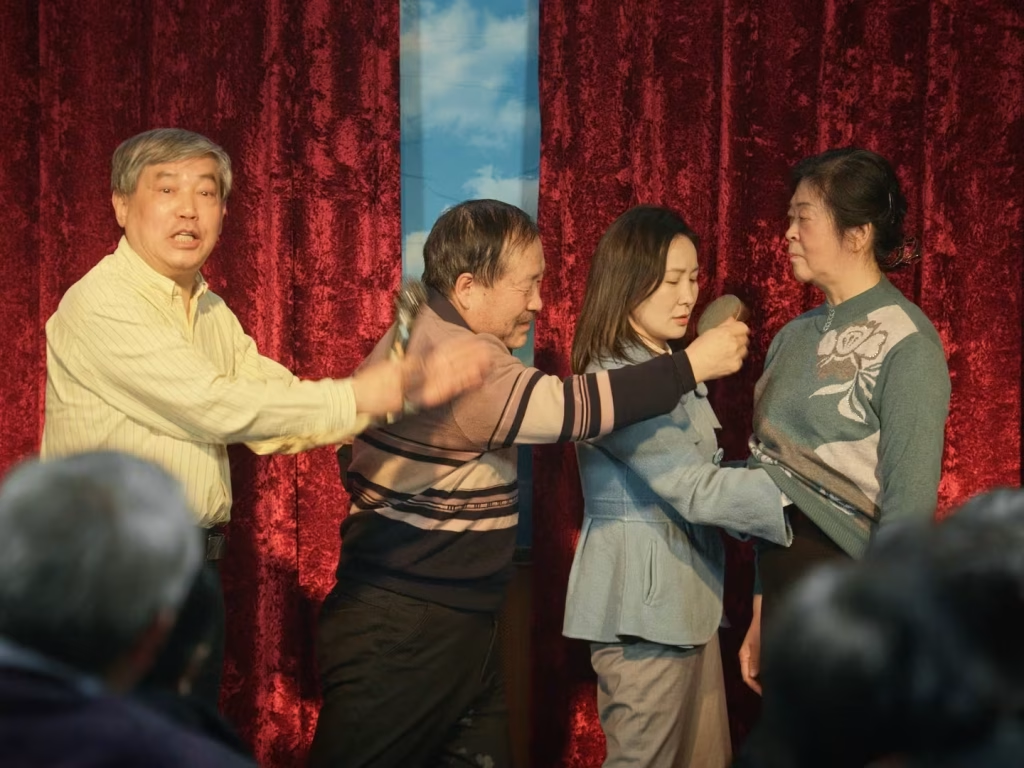
One of the film’s most memorable scenes takes place during the conference promoting a breakthrough cancer treatment. While everyone is completely focused on the stage, Lin moves through the crowd almost like a ghost. She even bumps into people, yet nobody acknowledges her. What does this scene represent for you?
Bo Hanxiong: That’s actually one of my favourite scenes in the film.
In China, gatherings like this are quite common, especially among elderly people.
Companies organise these events by promising miracle treatments or health products. They hand out small gifts, invite older people to attend, and eventually try to sell products that are often completely fake.
But over time, these gatherings become something much more complicated.
For many elderly people, they’re one of the few opportunities to leave home, spend time with others and feel that they belong somewhere.
The people selling these products understand that loneliness.
They slowly build trust.
Eventually, some elderly people begin believing not only in the products, but almost in the people selling them.
They become figures of authority—almost like religious leaders.
Within the film, the conference serves several purposes.
It suggests that the missing grandmother probably attended these gatherings regularly, which is why Lin searches for her there.
Because the event is about curing cancer, it also quietly hints that the grandmother herself may have been suffering from the disease.
But those details aren’t the most important part.
The real question isn’t whether the products are genuine.
The real question is what people choose to believe…
…and what they choose not to see.
Even when Lin walks directly through the crowd, interrupting the event and physically colliding with people…
…they choose not to acknowledge her existence.
That, to me, is the true meaning of the scene.
“When Lin finds the woman beneath the tunnel, that’s the moment she becomes alive again.”
Winter feels like more than just a setting in the film. It almost becomes a character itself, carrying both the harshness of life and Lin’s emotional state. What inspired you to use nature and the environment in this way?
Bo Hanxiong:
For me, winter naturally creates a sense of danger.
The moment you can see people’s breath in the cold air, the atmosphere immediately changes. It adds another emotional layer to every scene.
For elderly people, extreme winter conditions are genuinely life-threatening. I wanted the audience to constantly feel that danger surrounding the characters.
Sadly, this is something that really happens in China—and, I’m sure, in many other countries as well. Every winter, people lose their lives because of the cold.
Visually, winter also creates pressure.
The heavy clothing, the slow movements, and the frozen environment all reinforce the emotional weight that Lin is carrying throughout the film.
“I never thought about The Last Supper while making the film—but I really like that interpretation.”
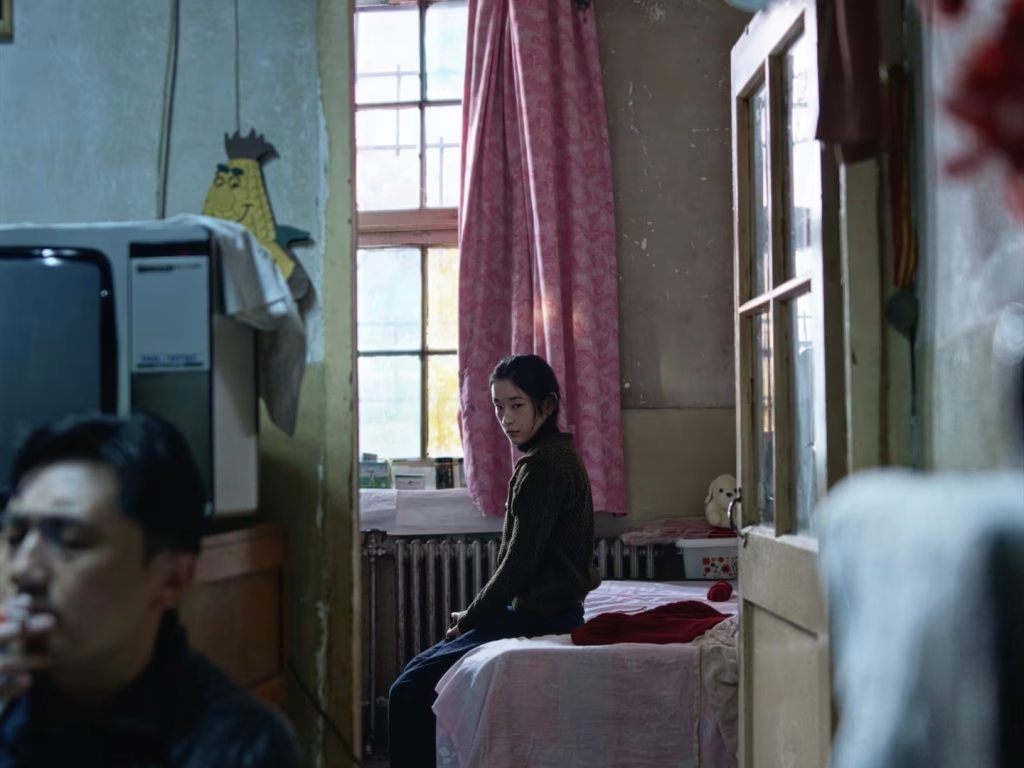
As the film approaches its ending, the music suddenly rises and Lin’s loneliness becomes even more overwhelming. The illuminated dinner table reminded me of The Last Supper, making me feel that Lin was no longer simply searching for someone, but confronting the possibility of death herself. Moments later, she walks fearlessly along the railway tracks before encountering a woman freezing beneath the tunnel. How do you interpret that ending?
Bo Hanxiong: First of all, I’d like to clarify one thing.
In my own interpretation, the woman Lin finds beneath the tunnel is not the missing grandmother.
I deliberately wanted to leave that open to the audience.
What truly matters to me is that, in that moment, both women finally find a sense of peace and connection.
In a way, they save each other.
Throughout the film, Lin keeps drifting farther and farther away from the city.
She gradually leaves behind the crowded neighbourhood where the grandmother lived and follows the railway into increasingly isolated spaces.
For me, the railway became a visual metaphor.
It connects the centre of society with those who have slowly drifted to its margins.
As for your interpretation of The Last Supper…
I honestly never thought about that painting while making the film.
But I really like that reading.
For me, the dinner scene represents something slightly different.
It’s the final gathering of people who have already become isolated from society.
Then the electricity suddenly goes out—which is something that genuinely happens from time to time in China.
Their final moment of warmth, entertainment, and togetherness simply disappears.
At that point, Lin decides to continue her own journey.
Perhaps she’s moving toward her own disappearance.
But everything changes beneath the tunnel.
That’s also the only moment when the camera finally moves close to her.
For me, that’s the moment when Lin becomes alive again.
She suddenly has another purpose.
From that point onward, her emotional journey changes completely.
“I want to tell stories that are deeply local, yet emotionally universal.”
You’ve developed a very distinctive cinematic voice through your work. Looking ahead, what kinds of stories excite you the most? And what can you tell us about the projects you’re currently working on?
Bo Hanxiong: I can’t reveal too much about my next project yet.
But when I look back at my first two short films, I realise they’re both about people who are drifting.
In many ways, I actually think they’re both road movies.
Even No One Knows I Disappeared feels like a road movie to me.
My first feature will probably continue in that direction.
It will be set in China and focus on young people, love, and contemporary Chinese society.
Studying filmmaking in the United States, living in China, and travelling regularly to European film festivals have all influenced the way I think about storytelling.
My goal has always been to tell stories that are deeply rooted in my own culture while remaining emotionally universal.
I want audiences from different parts of the world to recognise something of themselves in these stories.
That’s the balance I’m trying to achieve as I write my first feature screenplay.
Fatih Tuncay: Bo, thank you very much for your time. It was a pleasure talking with you, and I wish you all the best with your future projects.
Bo Hanxiong: Thank you. It was a pleasure talking with you too. I’d really love to visit Türkiye someday.
Fatih Tuncay: I hope you do. I’d also recommend the İzmir International Short Film Festival. It’s one of Türkiye’s oldest short film festivals and an Academy Award® Qualifying Festival. I think it would be a great place to showcase one of your future films.
Bo Hanxiong: Really? I didn’t know about that.
I’ll definitely look into it. Thanks for letting me know.
Fatih Tuncay: You’re welcome. I hope we’ll meet again in Türkiye.
Bo Hanxiong: I hope so too. Thank you.

Leave a Reply