



Sandra Wollner is a filmmaker drawn to memory, reality, and the uncanny corners of the human mind. After its world premiere at the 2026 Cannes Film Festival, Everytime (2026) had its regional premiere in the Competition Programme – Narrative Feature Film at the 32nd Sarajevo Film Festival. In the film, Wollner intertwines the unreliability of memory with the devastating consequences of an obsessive desire to carry on with life exactly where it left off after a loss.
Türkçe versiyonu için tıklayın. TR
How should we grieve? What remains after a loss? Fragments of memories in our minds, videos, photographs, perhaps even an Instagram account filled with joyful moments whose password no one knows.
Everytime follows a Berlin-based family confronted with a sudden tragedy and the grief that follows. Ella and her daughters, Jessie and Melli, are planning a holiday on the Spanish island of Tenerife. On the night before their departure, however, Jessie attends a party with her boyfriend, Lux. Under the influence of drugs and alcohol, Jessie falls from the roof of a high-rise building and dies. Lux survives a suicide attempt in the aftermath but finds himself unable to return to his former life.
No one in Jessie’s life is able to come to terms with her sudden death. Each of them tries to keep her alive by clinging to the memories she left behind. Their postponed grief, concealed beneath the pretence that everything is normal, eventually brings Ella, Melli, and Lux together. The three set off for Tenerife to take the holiday that never happened. As the journey unfolds, the boundaries between reality and illusion begin to blur, while memory and truth become increasingly unreliable for the viewer.

The Compulsion to Stay Happy
This is where one of the film’s most powerful underlying ideas emerges: the compulsion to be happy. The characters do not simply suppress their grief; they attempt to recreate a happiness that is no longer possible. The Tenerife holiday therefore becomes less a healing escape than a simulation of life before the loss. By postponing their grief, the three increasingly struggle to behave as though nothing has changed.
From this point onwards, Everytime begins to fracture reality not only through its narrative but also through its images. Cinematographer Gregory Oke, who shaped the visual world of concealed grief and retrospective memory in Aftersun, pushes the visual language of memory into something far more uncanny and suffocating in his collaboration with Wollner. While the images in Aftersun attempt to make sense of the past, remembering in Everytime increasingly begins to distort the reality of what has happened.

Melli, the youngest member of the family, is the first of the three to confront the irreversibility of the loss. She struggles to understand her mother Ella’s reactions; the decision to go on holiday and behave as though everything were normal makes little sense to her. Deep down, she knows that things cannot continue this way, and it is precisely this awareness that fuels her underlying anger towards her mother.
From Laughter to Tears: When Grief Loses Control
This emotional distance continues until one of the film’s most striking scenes. Three people who have been grieving separately suddenly find themselves sharing the same emotion. As Lux crouches down, he accidentally farts. At first, they all burst into hysterical laughter; then, almost without warning, the laughter gives way to an unbearable flood of tears.

An involuntary bodily reaction leads to uncontrollable laughter, and the laughter finally gives way to uncontrollable grief. Ella, who until then has remained almost impenetrable in the face of her loss, suddenly breaks down and begins to sob. It is at this moment that Melli understands that her mother is not indifferent; she has simply been experiencing her grief in an entirely different way.
There Is No CTRL+Z in Life
The Minecraft sequences take the film’s idea of irreversibility into another dimension. In a game, you can fall, die, and start again. You can rebuild a world you have lost or try another possibility after making a mistake. Everytime confronts this logic of gaming with the irreversibility of life. There is no “CTRL+Z” in reality. No matter how perfectly life before Jessie’s death is recreated, it cannot be restored.
It is under the weight of this irreversibility that grief finally becomes visible. The familiar “Five Stages of Grief” — denial, anger, bargaining, depression, and acceptance — cease to function as a linear path in Wollner’s world. Rather than simply reversing these stages, the film dismantles the very idea that grief can be divided into such orderly phases. The family’s apparently seamless adjustment initially resembles “acceptance,” yet it is actually one of the most intense manifestations of denial. From there, the stages do not replace one another; they coexist within the same fragmented landscape of memory.
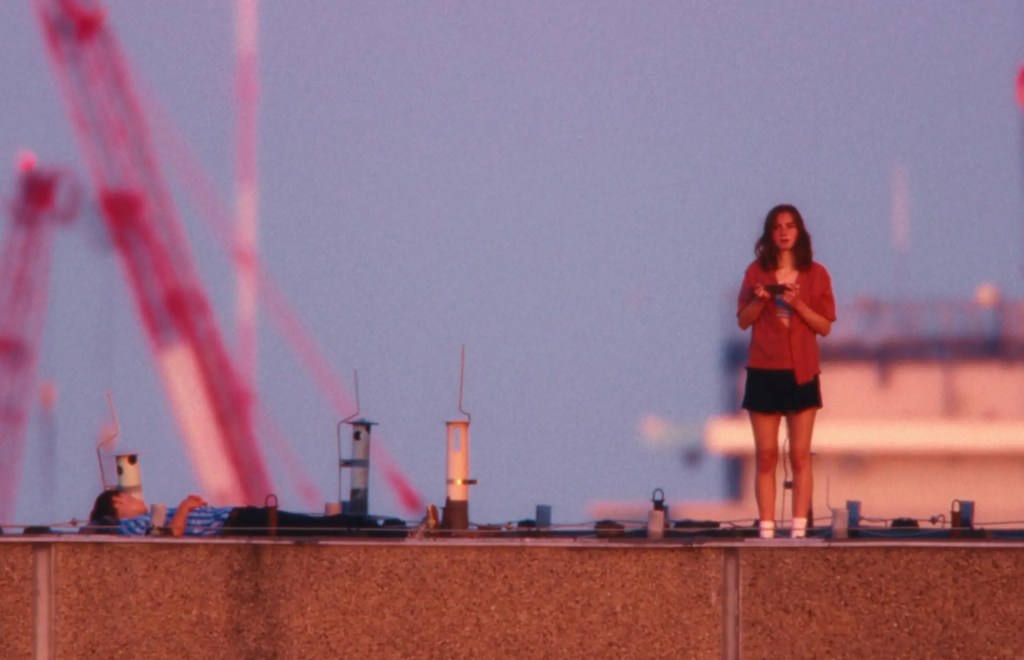
Watching Everytime, I found myself thinking about the strange silence of a social media account left behind after someone dies: the photographs remain, but the person who created them is no longer there. For me, this personal association deepened the endless sensation of falling that has haunted Wollner’s film from the beginning. In the final moments, time and memory become entangled, while the boundary between acceptance and denial grows increasingly uncertain. On the surface, life appears to return to its normal course, yet the life that existed before the loss survives only as a memory that can never be recreated.
Because grief is neither a five-point checklist to be completed nor a temporary pause that can be concealed beneath a holiday. In Everytime, grief means learning to breathe in the same room as those fragmented memories, within a life that offers no “CTRL+Z.”

Leave a Reply