


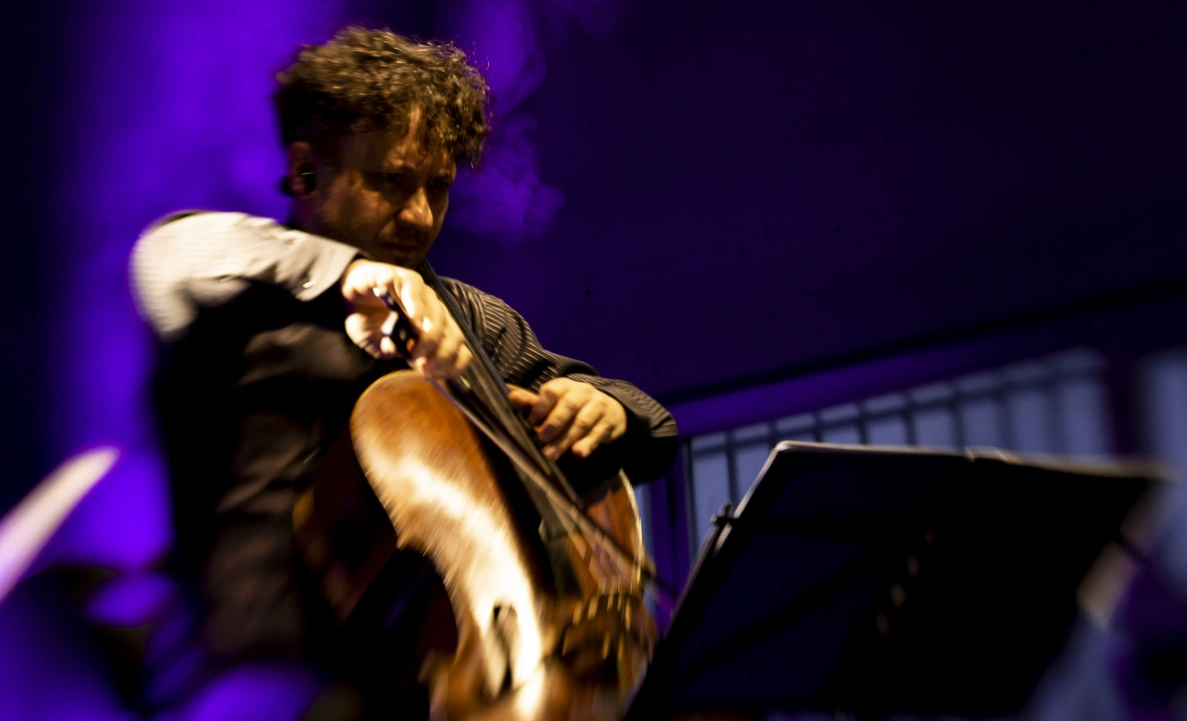
One of the leading figures of Italy’s contemporary classical music scene, Sandro Laffranchini has served as Principal Cellist of La Scala since 1999. In recent years, he has also developed UNCONVENTIONAL CELLO, a project that reimagines the traditional concert experience through a distinctly personal artistic vision.
Spanning everything from Bach and Telemann to The Beatles, his own compositions, and Ennio Morricone’s unforgettable Nuovo Cinema Paradiso, the programme transforms music into something that is not only heard, but experienced as a form of storytelling.
Presented at Prague’s historic Rudolfinum, the performance revealed an approach in which stories and personal reflections hold as much weight as the music itself, opening up compelling questions about the relationship between music, cinema, and narrative.
In this conversation, we spoke with Sandro Laffranchini about the origins of UNCONVENTIONAL CELLO, the evolving relationship between artists and audiences, the role of music in cinema, and the future of artistic expression in the age of artificial intelligence.
TR | EN | Türkçe versiyona buradan ulaşabilirsiniz.
“A driver may be exceptionally talented, but without a competitive vehicle, winning remains out of reach.”
You have been part of La Scala since 1999. Looking back, how has this institution shaped you not only as a musician, but also as a person and as an artist?
Joining La Scala as Principal Cellist was anything but straightforward. After numerous auditions in which I consistently reached the final rounds without ever securing the position, the turning point came thanks to Maestro Filippini, who lent me a Vuillaume cello. That instrument gave me a projection of sound that I believe made the decisive difference — I am genuinely convinced of it. In our profession, it is not unlike motorsport: a driver may be exceptionally talented, but without a competitive vehicle, winning remains out of reach.
On an institutional level, being part of La Scala means above all being a disciplined person. There are strict rules, and they must be respected.
As for developing a career outside the orchestra, I think this depends largely on personal initiative and on the relationships each individual is able to build beyond the institution. Not everyone has the same experience — some have received considerable support, others rather less — but that is no reason to lose heart. In my own case, I chose to develop what I would call a crossover language, because I have always been a passionate listener of music in the broadest sense, never limiting myself to the classical repertoire alone. This led me to pursue new territory with real determination: transcribing existing works, composing my own, and gradually building a musical voice that reflects the full range of what moves me.

What was the original impulse behind UNCONVENTIONAL CELLO? What aspects of the traditional concert recital format were you hoping to rethink or redefine through this project?
UNCONVENTIONAL CELLO was born during the lockdown. With the orchestra’s activity suspended, I suddenly had the time and mental space to think deeply about a new project — something I had perhaps been carrying inside for a while, but had never had the opportunity to develop fully.
I worked alongside composer Fabrizio Campanelli, a composer with deep roots in film music, whose experience in crafting sound for cinema brought a distinctive cinematic sensibility to the project. Together, working in his Candle Studio in Milan, we began exploring the cello’s sonic possibilities through electronic reworking. We transformed the instrument’s natural sound in ways that made it almost unrecognizable: at times percussive, at others evoking the texture of wind, or the resonance of a marimba — anything that could be extracted from the cello and reimagined into something genuinely unexpected. The premise was simple but radical: to take the cello as a starting point and see how far we could stretch it before it became something else entirely.
We then applied this approach to some of the most iconic pop songs, reworking their melodic and harmonic material and layering multiple cello recordings vertically, as though building an orchestral score from a single instrument. The result is a sound world that challenges what an audience expects the moment they see a cellist walk on stage. The project is available on Spotify and Apple Music.
“The premise was simple but radical: to take the cello as a starting point and see how far we could stretch it before it became something else entirely.”

The programme brings together a remarkably diverse repertoire, ranging from Bach and The Beatles to Morricone and your own compositions. How do you approach the dramatic architecture of a concert like this?
I felt that an audience coming to hear a cellist from La Scala would naturally expect a classical foundation — and that expectation deserves to be honoured. This is why I open with Telemann and move through to Bach: it establishes a credibility, a grounding in the tradition from which everything else flows.
From there, I think of the rest of the programme rather like a tasting menu at a great restaurant. The idea is to offer the audience a carefully chosen selection of strong, distinctive dishes — each one representative of a different flavour, a different world — so that someone encountering this music for the first time can experience the full range in a single evening. The hope, of course, is that if a particular piece sparks something in them, they will go further: explore that composer more deeply, discover the works that surround it, follow the thread wherever it leads.
The concert is not designed to be exhaustive — it is designed to open doors.
“The concert is not designed to be exhaustive — it is designed to open doors.”
As someone deeply rooted in the traditions of La Scala while also pursuing projects that challenge established boundaries, how do you view the relationship between tradition and innovation in artistic practice?
For me, tradition and innovation are not opposing forces — they are two dimensions of the same continuum. The clearest way I can illustrate this is through technique itself.
When I work on transcriptions and arrangements of popular music, I find myself constantly confronted with harmonic and rhythmic challenges that classical repertoire rarely demands in the same way: double stops, chords requiring two or three fingers to find their exact position simultaneously, with intonation problems multiplied accordingly. Far from being a detour from classical training, this kind of work pushes the technique forward — so that when you return to the traditional repertoire, what once felt demanding begins to feel relatively more manageable.
These arrangements are conceived as an evolution of classical technique, not as something entirely separate from it. The percussive effects and the sounds that imitate other instruments — almost like the different registers of a pipe organ — belong to the same logic: expanding what the cello can do, always in dialogue with what it has always done.
But beyond the purely technical dimension, I feel strongly that technique must ultimately serve a larger purpose: to express a language that is still evolving. And this is something I want to communicate especially to younger musicians. I believe the new generation can and should engage more actively with repertoire that goes beyond what is already available — beyond the standard library, beyond IMSLP. The existing canon is a foundation, not a ceiling. There is an enormous amount of musical territory still to be explored, transcribed, invented — and that work belongs to them.
“The existing canon is a foundation, not a ceiling.”
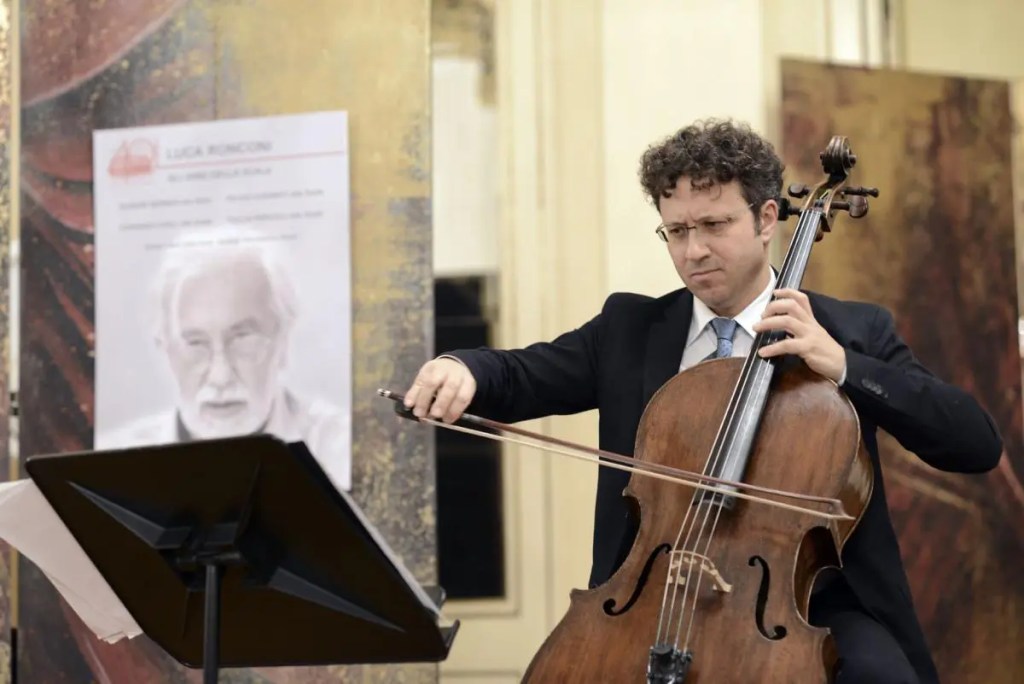
At a time when artificial intelligence is becoming increasingly involved in creative processes, how do you see the relationship between artists and audiences evolving?
I had the opportunity to hear a reconstruction of Beethoven’s Tenth Symphony at an important technology conference in Turin — a work built from a handful of surviving fragments and completed by artificial intelligence for full orchestra. While others in the room expressed moderately positive reactions, I personally found the result unconvincing.
What struck me most was the absence of genuine imagination. It was clear that the system was taking fragments of score and recombining them — rearranging, re-harmonizing, applying mathematical transformations such as retrograde or mirror inversions — but without any sense of organic thought. There was no coherent voice speaking from beginning to end, no sense that something was actually being said.
That said, I think it would be unfair to draw definitive conclusions from this. Musical composition is arguably one of the most complex things the human brain can do — it requires not only technical knowledge, but intuition, emotional memory, a sense of narrative, and the ability to sustain a coherent creative vision across time. Artificial intelligence, as it stands today, simply may not yet have sufficient processing power, training data, or contextual understanding to operate at that level. It may be a question of where the technology currently is, rather than where it is ultimately headed.
For now, I remain unworried that AI will replace human creativity in composition. But I watch the evolution with genuine curiosity.
“There was no coherent voice speaking from beginning to end, no sense that something was actually being said.”

Throughout the concert, you share stories, personal memories, and moments of dialogue with the audience. Does the emotional impact of a work of art come solely from the work itself, or are the stories surrounding it an essential part of the experience?
I believe that building a genuine relationship with the audience is essential — and I mean this in a theatrical sense, not merely as a matter of introducing pieces or providing context. What matters is empathy: the ability to create a real human connection in the space of just a few words or gestures, before a single note is played.
This is not easy. Speaking to an audience well is a skill in itself, and one that requires serious study. I am convinced that in the future, a truly complete musician will need training that goes well beyond the conservatoire — acting classes, theatre workshops, an understanding of how presence and communication work on stage. Our formation, however rigorous, is never quite enough.
We live in a world profoundly shaped by television, and even more so now by social media. We know very well that on Instagram, for instance, those who project a certain kind of image are able to convey their ideas far more effectively than those who do not. The same principle applies on the concert stage. Music alone is powerful — but the artist who can also tell a story, who can look an audience in the eye and make them feel something before the bow touches the string, operates on a different level entirely. In this sense, the boundaries between music, cinema, and storytelling are not so distant. They all depend, at their core, on the same thing: the ability to make another person feel that what is happening matters.
“The ability to create a real human connection in the space of just a few words or gestures, before a single note is played.”
“Music can hold time in a way that nothing else can.”
One of the highlights of the programme is Nuovo Cinema Paradiso, a score that continues to resonate deeply with audiences decades after its creation. What, in your opinion, makes certain film scores timeless?
Nuovo Cinema Paradiso touches something universal: the irreversibility of childhood. Those early years leave marks in us that never fully fade — places, dreams, a sense of belonging that we carry forward even as life moves on and offers no possibility of stopping.
This is precisely what Morricone understood so deeply: music can hold time in a way that nothing else can. And paradoxically, this is also why the live concert matters so much. A live performance exists in real time — it flows, it passes, it cannot be replayed. In this sense it mirrors life itself far more honestly than a recording we can revisit at will. The emotion is unrepeatable, and that is exactly what gives it its power.
“Great music is great music, regardless of the context in which it is born.”
Film music occupies an important place within your programme. How do you see the role of music in cinema? Are there emotions, ideas, or layers of meaning that music can communicate in a way that images alone cannot?
Music reaches a place that language cannot. Words are always a mediation — they can be interpreted differently, misunderstood, filtered through each listener’s own framework. Music bypasses all of that. It speaks directly to something more intimate and ancestral in us, something that precedes language entirely.
In cinema, this is precisely what makes music so powerful. Images show us what is happening; music tells us how it feels — and often, what it means. The two together create something neither could achieve alone.

“Music reaches a place that language cannot.”
In UNCONVENTIONAL CELLO, Bach, The Beatles, and Morricone can coexist within the same artistic space. What do these seemingly different musical worlds share in common from your perspective?
What unites Bach, The Beatles, and Morricone is, in my view, a deep rootedness in the classical tradition — even where it is least expected.
The Beatles are a perfect example. Their connection to classical structures is absolutely evident in the scores: think of Michelle, Yesterday, or Eleanor Rigby, with its string quartet running beneath everything. This is not pop music borrowing from the classical world — it is classical thinking expressed in a popular language.
Morricone always defined himself as a classical composer. He approached film music almost reluctantly at first, and for a long time the academic world looked down on him for it — including, notably, his own teacher. The dodecaphonic composers of his era kept their distance, dismissing film scores as somehow unworthy of serious consideration. Eventually, his international success made their skepticism impossible to maintain. But I think they simply failed to read the signs of the times.
Great music is great music, regardless of the context in which it is born. That is the thread connecting all three.
Final Thoughts
Throughout this conversation, Sandro Laffranchini reflects on music not only as performance, but as a form of storytelling, communication, and human connection. From La Scala to UNCONVENTIONAL CELLO, his artistic journey reveals a continuous search for new ways of reaching audiences while remaining rooted in tradition.
At a time when the boundaries between music, cinema, and narrative are increasingly fluid, his perspective offers a reminder that what truly endures is not the medium itself, but the ability to create meaning and emotion.
As Laffranchini puts it:
The concert is not designed to be exhaustive — it is designed to open doors.

Bir Cevap Yazın