


We discuss Iranian cinema and the festival’s evolution through the lenses of Abbas Kiarostami’s films with Hamed Soleimanzadeh, the director of the Koker Film Festival. Salute to the cinema that endures and resists against all odds of oppression, censorship, and restriction. Long live free cinema!
TR | EN | Türkçe versiyona buradan ulaşabilirsiniz.
You have a broad professional spectrum as a cinema researcher, critic, curator, and academic. As someone who has dedicated themselves to every field of cinema, you are organizing this festival in memory of Abbas Kiarostami, one of the most powerful names in world cinema. Could you please introduce yourself to our readers?
I was born in 1987 in Mashhad, one of the major cities in Iran. My early encounter with cinema was shaped through my father’s interest in film. At a young age, I watched The Cow by Dariush Mehrjui, which left a deep impression on me and became the starting point of my enduring fascination with cinema though not in a conventional cinephile sense, but rather through what one might call an “auteurist” or arthouse orientation.
During my adolescence, I was actively involved in acting and filmmaking in my hometown, which eventually led me to pursue formal academic studies in theatre directing. I hold a BA in Theatre Directing, an MA in Dramatic Literature, a PhD in Art Research with a focus on Film Studies, and a postdoctoral specialization in Film and Philosophy.
Throughout these years, I have directed several short films. My most recent work, The Shell, was co-directed with Hakan Ünal and filmed in Turkey. Alongside filmmaking, I have been engaged in teaching in various countries, working with international student communities.
I have also published books and academic articles, and have served as a jury member and programmer for several internationally recognized and reputable film festivals.
In short, I can be described as someone who is continuously in search of understanding cinema and, in a broader sense, in search of understanding oneself through cinema.

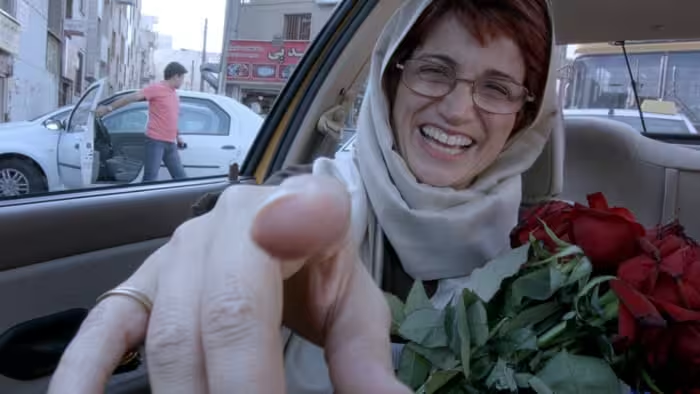
We are all citizens of the world who love cinema. As Jafar Panahi says in his film Taxi Tehran (2015), “Nothing bad comes from people who love cinema.” I wholeheartedly agree with this sentiment. Looking at your journey in cinema, I see that your path has also crossed through Istanbul. How was your experience serving as a jury member in Istanbul?
It is true that we are all lovers of cinema, but Panahi’s statement is relative. Bad actions come from everyone whether they love cinema or not but as a hopeful slogan, it carries a meaningful sense of optimism.
To answer your question: yes, in 2022 I served as a FIPRESCI jury member at the Istanbul Film Festival. Interestingly, we awarded the prize to the compelling film Vortex, directed by Gaspar Noé.
That trip was one of my most memorable festival experiences, partly because my parents were in Istanbul at the same time, so we explored the city together and shared many meaningful and engaging walks and conversations.
Regarding the festival itself, I must say it was organized in a fully professional manner, with a diverse selection of films, experienced collaborators, and well-curated side programs. It was truly an unforgettable experience for me.
Istanbul, I should also add, is one of the most vibrant cities in the world. Even with its constant and sometimes exhausting traffic, that very congestion creates a strange kind of life experience where waiting in cars and observing the flow of movement allows you to experience a kind of “non-mechanical” or reflective urban existence, as if life itself is being contemplated through delay and motion.
Additionally, I am curious about your perspective on cinephiles in our country. There is a large audience in Turkey that is deeply in love with Iranian cinema; our two countries are in close contact regarding film culture. Having served on juries at the world’s most prestigious festivals such as Berlin, Cannes, and Istanbul, what are your thoughts on Turkish Cinema today?
As you know, there is a deep and long-standing historical bond between Iran and Turkey, which has extended even into the layers of everyday and popular culture. I remember that in my childhood, just as we followed Iranian singers, many Iranian households were filled with Turkish music as well, even without fully understanding the language. This linguistic exchange between Persian and Turkish is also fascinating; we sometimes use Turkish words, and I know that many Persian words have also entered your language.
Naturally, this cultural closeness extends to cinema as well. From my perspective, Turkish cinema has, at certain periods, been significantly influenced by Iranian cinema, and this may be due to the poetic and distinctive nature of Iranian filmmaking and major figures such as Abbas Kiarostami. It is needless to say how many contemporary Turkish filmmakers have referred to him as a source of inspiration, including Nuri Bilge Ceylan.
Personally, I greatly appreciate Turkish art cinema both short and feature films. I also watch many strong Turkish films that are not limited to well-known names, and a new generation is emerging that takes cinema very seriously.
If the space dominated by commercial production and extensive advertising could allow a bit more breathing room for Turkish art cinema, I believe there is still strong reason to remain hopeful about the future of Turkish cinema.

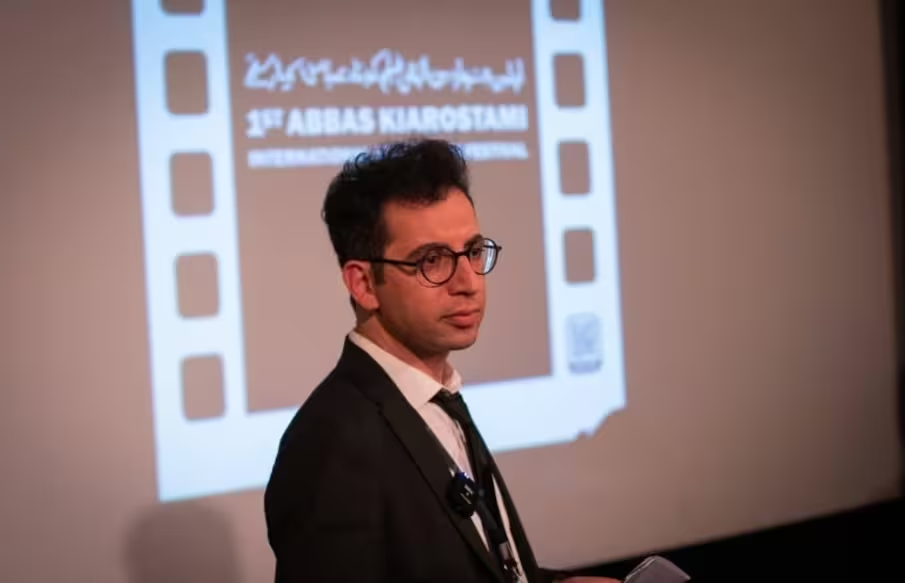
Now, I would like to move on to my questions regarding the Koker Film Festival. The festival takes its name from Abbas Kiarostami’s “Koker Trilogy.” Furthermore, the name was changed this year from the “Abbas Kiarostami Short Film Festival” to the “Koker Film Festival.” Could you share with us the origin of the festival and the process of bringing the team together? In this festival, you focus specifically on short films. Is there a particular significance or reason behind this choice?
About three months before the first edition of the festival in 2024, I came across an Instagram post about Kiarostami that felt quite different from the usual narratives. Given my long-standing passion for his cinema and my extensive experience in film festivals, the idea came to me that it might now be the right time to establish a festival dedicated to him, inspired by his cinematic spirit and aesthetic approach.
I shared the idea with the Kiarostami Foundation, and in particular with his elder son, Ahmad Kiarostami. With a very modest personal budget, and the support of a few friends, small film companies, and a professional team of volunteers based in Berlin and Tehran, we managed to bring the first edition of the festival to life.
For the inaugural edition, we received around 1,000 film submissions from all over the world. This remarkable response was both unexpected and deeply encouraging, and it motivated us to continue developing the project.
In the second edition, we expanded the festival by adding a short screenplay section, which also received very strong engagement. Ahead of the third edition, after discussions with the Kiarostami Foundation, we collectively decided to rename the festival from the “Abbas Kiarostami International Short Film Festival” to the “Koker International Short Film Festival.” The reason behind this was both symbolic and conceptual: Koker is not only a village in Iran but also a direct reference to Kiarostami’s iconic Koker Trilogy. At the same time, like many major international festivals named after locations, it gives the festival a broader, more universal identity beyond a single individual name.
The current edition of the festival will take place from July 1st to 3rd at the historic Klick Kino in Berlin, the same venue that hosted the previous editions. We also align the festival with the anniversary of Abbas Kiarostami’s passing, in order to strengthen its conceptual and emotional connection to his legacy.
Despite the current difficulties caused by geopolitical conditions and internet restrictions in Iran, we continue our work with determination. The festival features two main sections short films and short screenplays and is supported by distinguished juries whose presence has significantly contributed to its credibility and international profile.
The Koker Film Festival is a specialized short film festival dedicated to promoting independent, poetic, and reflective cinema. While we remain open to diverse genres, our core focus is on supporting arthouse cinema rather than commercial production, which unfortunately has increasingly overshadowed short filmmaking today. This commitment to independent cinematic expression remains the central direction of our work.
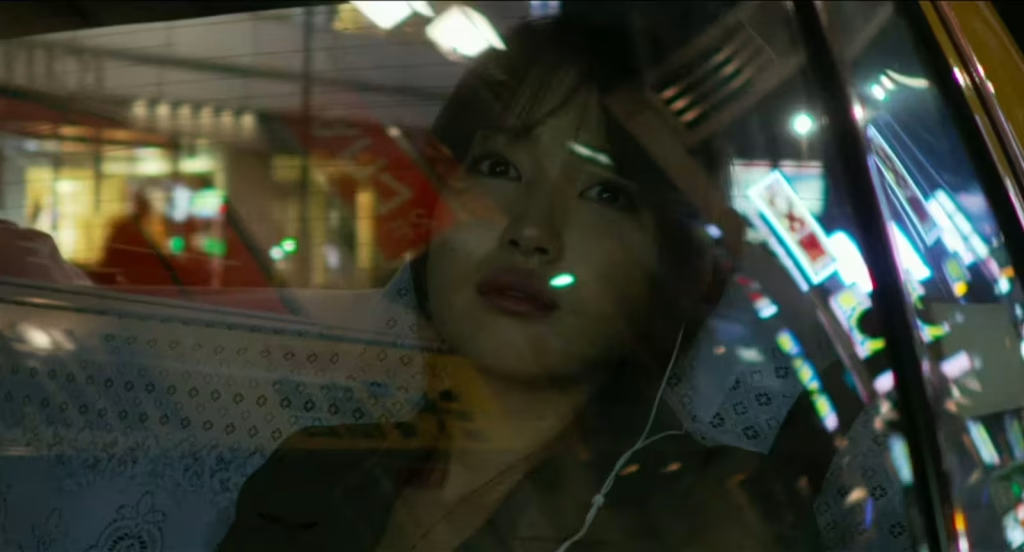
Abbas Kiarostami is one of the key figures who introduced the Iranian New Wave to Europe and the rest of the world a universal and immortal director. I am particularly curious about how Kiarostami is interpreted from a Western perspective. For instance, Certified Copy (2010) and Like Someone in Love (2012) were two significant films where he moved away from Farsi and utilized the languages of the geographies where the films took place. How do you evaluate this transition?
Kiarostami is, above all, a symbol of cinematic experimentation. He was deeply in love with an exploratory approach to cinema, and it is precisely this spirit that granted him his unique global position and artistic sincerity.
We still remember how audiences at Cannes were surprised after the final sequence of Taste of Cherry (1997), sensing that something new had been added to the language of cinema although this innovation had already been clearly anticipated in earlier works such as Close-Up (1990). In this sense, Kiarostami was never merely an “exotic Eastern auteur” for Western audiences, a label that often reduces non-Western filmmakers to cultural curiosity. Instead, he fundamentally re-centered cinema on the question of human existence.
His cinema is built around simple human beings placed in complex situations the very condition that resonates with contemporary life, where complexity increasingly defines everyday experience. What distinguishes Kiarostami, however, is his unique selection of situations and his minimalistic yet deeply layered approach to them.
His films made outside Iran continue this trajectory of experimentation and aesthetic inquiry. However, it is true that these works did not achieve the same level of resonance as his earlier Iranian films. In my view, one reason for this is his deliberate distance from his earlier cinematic context and established method. Nevertheless, this was an important artistic choice: he consciously tested the boundaries of his own language, ensuring that his cinema would not become a fixed statement or a repetitive style.
I respect this shift deeply. It demonstrates that Kiarostami was not interested in producing a closed or finalized cinematic system, but rather in constantly rethinking cinema itself. In that sense, his later works also influenced many filmmakers by showing that artistic integrity sometimes requires leaving one’s comfort zone, even at the risk of uneven reception.
Based on what I have gathered, you established this festival with the aim of transmitting Kiarostami’s cinematic language, simplicity, and philosophy to younger generations. The festival brings together independent and artistic short films from all over the globe. In fact, all this information seems to support Kiarostami’s perspective on cinema and his ideology of “timelessness,” doesn’t it?
Yes this is a fair interpretation. From a philosophical and theoretical perspective, Kiarostami’s cinema can be understood as an aesthetics of de-historicized presence not in the sense of being ahistorical, but in the sense of suspending cinema from the urgency of narrative time, ideological time, or event-based historicity. His films often resist closure, resolution, and even authorial certainty. Instead, they open a space where meaning is continuously deferred and reconstructed by the viewer. This is precisely where the idea of “timelessness” becomes relevant: not as an absence of time, but as a displacement of chronological determinism in favor of experiential duration.
In this sense, a festival inspired by Kiarostami cannot simply function as an exhibition platform. It inevitably becomes a curatorial extension of his epistemology of cinema that is, cinema as a mode of thinking rather than a system of representation. The emphasis on short films is particularly significant here, because the short form, when stripped of industrial expectations, often returns cinema to its most fundamental condition: a concentrated encounter between perception, time, and ambiguity.
However, one important theoretical nuance should be added. What you call “transmitting Kiarostami’s language” should perhaps not be understood as reproduction or preservation of a stylistic model. Kiarostami himself repeatedly resisted stylistic fixation. His “language” is not a set of formal devices, but rather an ethical-aesthetic stance toward reality: minimal intervention, openness to contingency, and respect for the autonomy of the real.
So yes, your reading is fundamentally valid but with one critical refinement: what is being extended here is not a doctrine of timelessness, but a method of thinking cinema that constantly resists becoming timeless in a static sense.
There is a crucial point you emphasize in your articles: the “gaps” in Kiarostami’s cinema. You argue that these gaps are filled by the audience with a philosophical depth meaning the film continues within the viewer’s mental space even after it ends. From a theoretical standpoint, could we categorize Kiarostami within the “Formalist School of Cinema,” or do you see him elsewhere? On the other hand, Kiarostami is a director who utilizes “montage” exceptionally well. How does his editing style contribute to this mental space?
From a theoretical standpoint, I would be cautious about placing Kiarostami strictly within the “Formalism” school of cinema. While his work clearly demonstrates a highly conscious attention to form, structure, and cinematic construction, reducing him to formalism would miss the deeper epistemological dimension of his cinema.
Classical film formalism tends to emphasize the autonomy of cinematic form how meaning is generated primarily through stylistic and structural devices such as framing, montage, rhythm, and composition. Kiarostami certainly uses all of these elements with extraordinary precision, but in his case, form is never self-contained. It is always directed toward something beyond itself: perception, uncertainty, and the spectator’s cognitive and emotional participation.
In this sense, Kiarostami is closer to what we might call a “philosophical minimalism” or even a “phenomenological cinema.” His films are constructed in such a way that meaning is not delivered, but activated in the viewer. The so-called “gaps” in his cinema are not simply absences; they are structured epistemic spaces. These gaps function as invitations for interpretive completion, where the viewer becomes a co-producer of meaning.
This is where montage becomes crucial. Kiarostami’s editing does not merely serve continuity or narrative clarity. Instead, it often operates as a discontinuous logic of thought. By withholding information, cutting away from expected resolutions, or placing seemingly simple shots in tension with each other, he creates a temporal and cognitive delay. This delay is essential: it prevents immediate consumption of meaning and forces reflection.
For example, his use of off-screen space, prolonged shots, or abrupt structural shifts produces what we might call “mental extension” of the film. The montage does not close meaning; it opens it. It activates the viewer’s imagination, memory, and ethical judgment. In this way, the film continues after it ends not as narrative continuation, but as an internal process of thinking.
So rather than categorizing Kiarostami within strict formalism, I would argue that he transforms formal devices into philosophical instruments.

Today, when we talk about Iranian cinema, we see it breaking away from the representations dictated to us. Films like Holy Spider, Hit the Road, Until Tomorrow, and My Favourite Cake allow us to move beyond conventional stereotypes. I personally find Iranian cinema quite “Western” in its essence. I must confess that when I visited Iran, I encountered a country very different from what is often shown to us. What do you think is the reason for this shift in Iranian films, or how did this “originality” evolve?
In my view, the shift you are referring to in Iranian cinema is the result of a complex historical, social, and aesthetic process rather than a sudden stylistic transformation. Iranian cinema has always operated in a kind of in-between position: on the one hand shaped by conditions of production, censorship, and social constraints, and on the other hand continuously seeking to develop a personal and creative language for representing reality. This tension has often produced a highly inventive cinematic form, particularly in terms of narrative structure, visual economy, and indirect modes of expression.
Given your experience of visiting Iran and regarding the images constructed by global media, it is important to emphasize a fundamental point: media representation is never identical to lived reality. Media systems inevitably function through selection, framing, and simplification, whereas social reality is far more layered, heterogeneous, and contradictory. The gap between representation and lived experience is therefore not accidental, but structural. This is something I have personally experienced as well; direct encounters with a society almost always reveal a different, more complex reality than the one mediated through dominant visual narratives. This discrepancy is a natural feature of how images are produced and circulated in the contemporary world.
As for what you call the “Originality” of Iranian cinema, I would interpret it less as an essential quality and more as the outcome of this very tension between reality, constraint, and creative expression. Many Iranian filmmakers have been compelled to develop indirect, symbolic, or minimalist modes of storytelling in order to articulate human experience within specific limitations. Paradoxically, this condition has often led to a highly distinctive cinematic language that resonates beyond its immediate cultural context.

You served as the Director of the Short Film Section at the Woman Life Freedom festival. Women’s rights are a vital issue concerning all people worldwide. In this context, when we look at the portrayal of female characters in Kiarostami’s cinema, we see naive and calm figures; however, these women stand out with their uniquely strong stances. As I mentioned earlier, films like Certified Copy (2010) and Like Someone in Love (2012) differ from his others in terms of female representation. Could the reason for this be purely geographical?
Women’s rights are undoubtedly one of the most important issues, and especially in the last three years after the “Woman, Life, Freedom” movement in Iran this issue has become much more visible and central. Despite many limitations, it has also led to meaningful cultural and social outcomes.
After the Islamic Revolution in Iran, according to the regulations of the Ministry of Culture and Islamic Guidance, female characters were required to appear with hijab even in interior domestic scenes in films and television productions. Kiarostami, however, never accepted this rule as a natural or realistic mode of representation. He considered it artificial in the context of storytelling and everyday realism, and therefore he avoided placing women in domestic apartment settings in a conventional narrative framework. In fact, this limitation contributed to the marginalization or reduction of female characters in some of his earlier works, not because of an absence of interest, but because of a tension between his aesthetic realism and the imposed representational codes of the system.
Later, in Ten, he returned to the subject of women in a very significant way, but through a completely different formal strategy. Here, the woman is not a secondary figure within a classical narrative structure; instead, she becomes the central driving force of the film through conversations, driving sequences, and a fragmented cinematic form. The film Shirin (2008) also continues this trajectory, placing women this time professional actresses at the center of the cinematic experience, where their emotional and perceptual responses become the main subject of the film itself.
Finally, when we look at Kiarostami’s films made outside Iran, we can clearly see a shift in the presence and construction of female characters. In works such as Certified Copy and Like Someone in Love, women appear in more ambiguous, psychologically layered, and culturally less constrained contexts. This difference is not simply geographical, but also structural: outside Iran, Kiarostami was no longer working within the same institutional and representational restrictions, which allowed him to explore gender, identity, and interpersonal relations with greater fluidity. At the same time, this also led to a different kind of cinematic uncertainty, where female characters are less anchored in a specific social code and more open to interpretive ambiguity.
Overall, we can say that the role of women in Kiarostami’s cinema evolves from being partially constrained by institutional conditions in Iran, to becoming structurally central in films like Ten (2002) and Shirin (2008), and finally transforming into more fluid, transnational, and philosophically open figures in his international works.
Thank you very much for accepting my interview invitation. Is there anything else you would like to add?
Thank you very much for your invitation. You asked very thoughtful questions. I would like to take this opportunity to encourage all young and independent filmmakers in Turkey to follow and engage with the Koker International Short Film Festival.

Bir Cevap Yazın