


The Sarajevo Film Festival programmer and screenwriter reflects on the festival’s founding spirit, the changing image of Southeast European cinema, the freedom she finds in writing and her long-standing connection with Turkish filmmakers.
The Sarajevo Film Festival programmer and screenwriter reflects on the festival’s founding spirit, the changing image of Southeast European cinema, the freedom she finds in writing and her long-standing connection with Turkish filmmakers.
Röportajın Türkçe versiyonu için bağlantıya tıklayın. TR
Elma Tataragić joined the team behind the Sarajevo Film Festival while the city was still under siege. Today, she works as a programmer for the festival’s Competition Programmes and CineLink Industry Days. She is also a professor of screenwriting and one of the screenwriters behind internationally recognised films including Snow, God Exists, Her Name Is Petrunya and The Happiest Man in the World.
Tataragić has followed Turkish cinema closely for decades. She has taken part in industry events including the Work in Progress Platform at the Bosphorus Film Festival and TRT 12 Punto, while numerous films from Türkiye have appeared in Sarajevo Film Festival programmes over the years.
In this edition of Sinefil Atak Industry Talks, Elma Tataragić discusses a formative memory from the first Sarajevo Film Festival, the changing international perception of Southeast European cinema, the distinction between inspiration and imitation, and the place of Turkish filmmakers within the festival landscape.
This interview was conducted in English during the 32nd Sarajevo Film Festival and has been edited for length and clarity.
“For some children, it was the first time they were watching a film. It was a beautiful picture.”
You were very young when the Sarajevo Film Festival was founded, while the city was still under siege. What is the most powerful image you remember from those days? Do you still feel the same passion that inspired you to start the festival?
I had already been working with the team at Obala Art Center, the organisation behind the Sarajevo Film Festival, for a year or two. I was part of the film department, organising different screenings. Then we decided to create the festival.
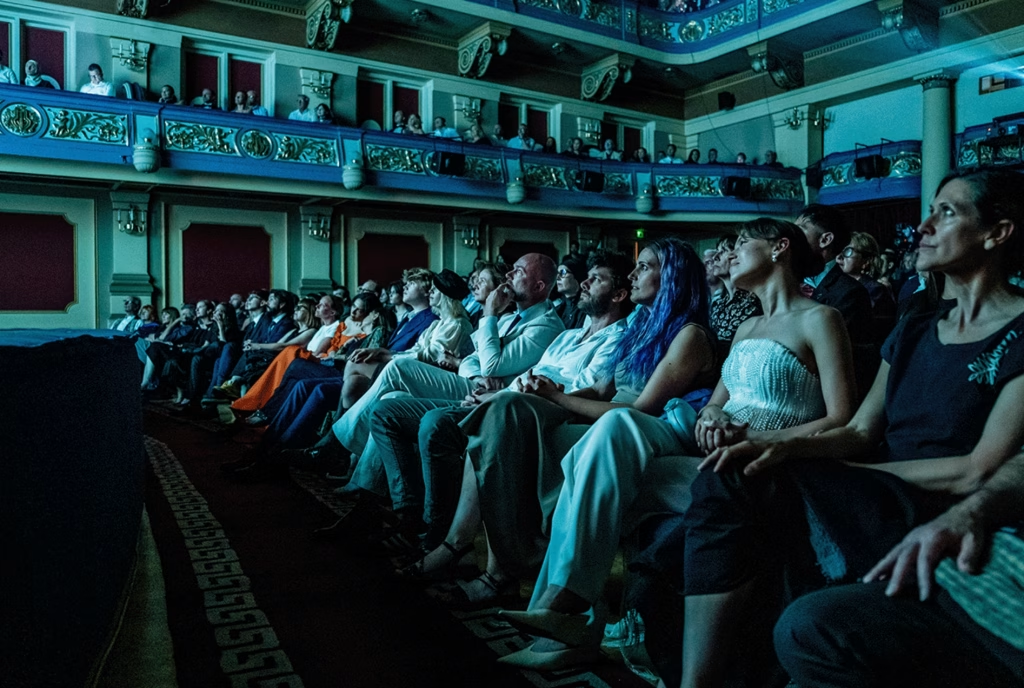
If I had to choose one image that has stayed with me from the first Sarajevo Film Festival, it would be the hall filled with children for a screening of A Little Princess by Alfonso Cuarón, who came to Sarajevo. It was the first screening organised for children after two and a half years of war. For some of them, it was the first time they had ever watched a film. It was a beautiful picture.
I am still excited about the festival, and I still have the passion to do it, but it is different now. At the beginning, we were trying to make life easier for the people of Sarajevo, which was one of the worst places in the world to be at that time. We wanted to offer films, entertainment and thoughts about the world outside.
Today, we run a major film festival. We promote filmmakers from around the world and have a large industry platform and market for new projects. The position of the festival has changed greatly over the past thirty years.
“The bridge between the audience and the films is something the festival has to nourish and cherish.”
What is the one founding value that the Sarajevo Film Festival must never lose?
For us, it is certainly important to promote films from this region. But it is not only about promoting films; it is also about encouraging dialogue between filmmakers, films and audiences. The bridge between the audience and the films is something the festival has to nourish and cherish.
“The new generation has moved this perspective, and I think it will continue to move even further.”
The Balkans, Türkiye and the surrounding regions are often viewed through stories of war, poverty and social suffering. When selecting a film, how do you distinguish an authentic story from an image of a “suffering region” expected from the outside?
One does not necessarily exclude the other. The theme of a film is not what matters most. What matters is whether the filmmaker and the film crew manage to say something different about that particular subject. That is what we look for.
It is difficult to define what others expect from films coming from Southeast Europe. For a long time, images of war, conflict, transition and post-transition shaped the international perception of Southeast European cinema, including the region we promote.
Today, however, it is difficult to claim that this still defines our cinema. If you look at the films in competition now, they are extremely diverse and very different from the films made twenty years ago. The new generation has shifted this perspective, and I believe it will continue to move even further.
“When I write, that is my space of freedom.
You watch films both as a screenwriter and as a festival programmer. Does programming give you more freedom when you write, or does it sometimes limit you?
We are all accustomed to playing different roles in everyday life. In one situation, you are a student; in another, a patient, a wife, a husband, a mother, a son or a daughter. Moving between different roles is part of life.
Programming films and writing are two different things. When I programme films, I am a programmer; I do not think of myself as a screenwriter. I try to look at the film as a whole: not only at the story, but also at the cinematography, acting, context and everything else that makes a film.
At the same time, being able to make films myself is very liberating. Writing is my place of freedom. When I programme, I am curating other people’s stories and other people’s freedoms. When I write, it is mine. That is the space where I can be myself.
“There is no recipe. That is why film is beautiful: it is art.”
When writing a screenplay, do you think about its possible festival journey?
Never. I write because I believe there is an interesting story and something meaningful to say. I do not write while thinking, “This will be interesting for Berlin.” How could I know what will happen? You may have a beautiful idea and a beautiful screenplay, but the film can still turn out badly. You never know.
If there is genuine passion behind a film—whether in the writing, directing or acting—that passion will be recognised. There is no recipe. That is why film is beautiful: it is art.
“I cannot be Nuri Bilge Ceylan, but I can be Elma Tataragić.”
Young filmmakers can be strongly influenced by successful auteurs. Where do you draw the line between inspiration and imitation?
Nuri Bilge Ceylan is Nuri Bilge Ceylan. I cannot be Nuri Bilge Ceylan, but I can be Elma Tataragić. Everyone should think about their own voice rather than trying to become someone else.
Of course, coincidences happen. You can write a film and then discover that someone else is working on the same subject. That is natural. Copying is different, but being inspired by someone is valuable and beautiful. Artists have always been inspired by other artists.
“Three Monkeys, for me, is one of the best films I have seen.”
Is there a filmmaker from Turkish cinema whose work you particularly follow, and a Turkish film that has stayed with you?
Nuri Bilge Ceylan is certainly one of those filmmakers. Three Monkeys, for me, is one of the best films I have seen. Emin Alper is another very important filmmaker, and there are many more.
I have been travelling to Türkiye for around twenty-five years, at least once a year, attending different film festivals. Türkiye is a large country and produces many films, and I try to watch and follow as many of them as possible.
Throughout the festival’s 32 editions, we have presented many filmmakers from Türkiye in Sarajevo—in the feature, short, documentary and student competitions, as well as in other sections. We have close connections with Türkiye and with Turkish filmmakers.
“It is not Eurovision; it is a film festival.”
What excites you most about projects and films coming from Türkiye?
When I read a project or watch a film, I do not begin by thinking, “This is from Türkiye,” “This is from Georgia,” or “This is from somewhere else.” Where it comes from is not the deciding factor. I try to look at each film as a work of art rather than as a national representative. It is not Eurovision; it is a film festival. You do not need every country to be represented. You are trying to select the best films available.
Every year is different. There was a year when three of the nine films in our feature competition came from Türkiye—around thirty per cent of the selection. This year, we do not have a Turkish-directed film in the feature competition, but we do have one in the short film competition.
Discovering Sis Gürdal’s Porkatal was an exciting moment. My preselection team first saw it and told me, “We have found this beautiful Turkish short film; you have to see it.” Then I watched it, and I agreed.
Editor’s note: Türkiye is also represented in the 2026 Narrative Feature Competition as a co-production partner on Ana Urushadze’s Supporting Role, a Georgia–Estonia–Türkiye co-production.

Leave a Reply