

When discussing cinema, we often focus on the stories films tell. Yet there is another, less visible but equally decisive dimension: the industry itself.
How does a film position itself on a path that stretches from local production to the international festival circuit? How can an independent filmmaker build a sustainable production and festival strategy with limited resources?
Having gained visibility at national and international festivals through his short films, and now continuing his work under his own production company, REMZ Film, Nuri Cihan Özdoğan stands at a pivotal moment in his career with his debut feature film, Dead Dogs Don’t Bite.
Bringing the production model he developed locally into the realm of feature filmmaking and international circulation, Özdoğan offers a concrete example of how an independent film is built, developed, and strategically positioned step by step.
In this edition of our Industry Talks series, we take a closer look at a film’s journey from its initial conception to its festival run, examining the strategic decisions, turning points, and lessons learned along the way.
TR | EN | Türkçe versiyona buradan ulaşabilirsiniz.
You only need one reason to make it: cinema itself.
Fatih Tuncay: When choosing the project that would become your first feature film, what was the primary factor that led you to commit to Dead Dogs Don’t Bite among the various ideas you were developing: the story’s potential, its financing prospects, or its perceived festival potential?
Nuri Cihan Özdoğan: That it was a realistic project to make. I’m saying this very directly: above everything else, what mattered most was that Dead Dogs Don’t Bite was a project we could realistically pull off without any funding support.
At the time, I had several screenplays that had been invited to various script development platforms over the previous five years. One of them had even been invited to present before the Ministry’s funding committee, but the project was postponed for reconsideration by the next board. About six months later, my close friend and longtime creative companion, Tunahan Kurt, and I attended the interview for that project. When we walked out of the room, we both knew we were not going to receive the support.
On the way back, we made a promise to ourselves: until I stepped onto the set of my first feature film, we would not apply to any fund or project development programme again.
Of course, Dead Dogs Don’t Bite addresses an issue that I find deeply important. It is rooted in the local realities of the region where I live alongside the people I care about, while also carrying a strong universal resonance. If I hadn’t believed in that from the very beginning, I would have dismissed the idea long before it ever became a screenplay.
When it came to choosing which film to make, the deciding factor was that Dead Dogs Don’t Bite was more feasible than my other projects.
During that period, the magic touch of my producer and older brother, Kaan Özdoğan, whose support I have felt by my side throughout my life, became part of the project. Our co-producer, Hok Film, also joined the film and made a tremendously valuable contribution.
The irony is that the financing I had been unable to secure for five years was completed within just five months after we decided to make Dead Dogs Don’t Bite.
Rather than promising technical perfection, we wanted to present a world with a soul.

How did you prepare for the Meetings on the Bridge Work in Progress process? When presenting an unfinished version of the film to international industry professionals, which aspects of the story, tone, and market positioning did you choose to emphasize? What tangible impact did this process have on the project, and would you describe it as a turning point?
For years, I had been looking for funding for my other screenplays, but I had never applied to a single fund or project development platform with Dead Dogs Don’t Bite. Not because I lacked confidence in the script, but perhaps because I thought it might be considered too harsh by the people responsible for approving projects. In other words, I had gone into production without passing through any kind of “approval mechanism.” Yet while we were shooting, I knew, for better or worse, that I was making exactly the kind of film I wanted to make.
Still, I was curious to see how the film would be received. The moment we learned that we had been selected for Meetings on the Bridge was, in itself, a turning point for me.
Together with our editor, Hakan Çelik, we prepared a twenty-minute excerpt from the film for Meetings on the Bridge, and in doing so we benefited greatly from our background in short filmmaking. Of course, we wanted to convey the film’s narrative and atmosphere, but what mattered even more to us was whether people could feel the spirit behind it. Rather than promising technical perfection, we wanted to present a world with a soul.
When we finally watched the selected footage together with the guests at Meetings on the Bridge, I had the feeling that they wanted to know more about the world we had created. They were curious about its streets, its rules, its people, even its smell. We had managed to invite them into the film’s world with sincerity.
Meetings on the Bridge did far more than provide international visibility for our project. From the moment we joined the programme, it became a companion on our journey. We were no longer alone.
It was a tremendous stroke of luck for us to be part of the programme during a period when Başak Hanım, Pınar Hanım, and their team had given Meetings on the Bridge such remarkable momentum. Although we were a filmmaking team based in Adana, working far from the industry’s traditional centres, Meetings on the Bridge marked the beginning of our film’s international journey.
How did your roadmap evolve after Meetings on the Bridge? Which support programmes did you choose to prioritise, and what were the main criteria behind those decisions?
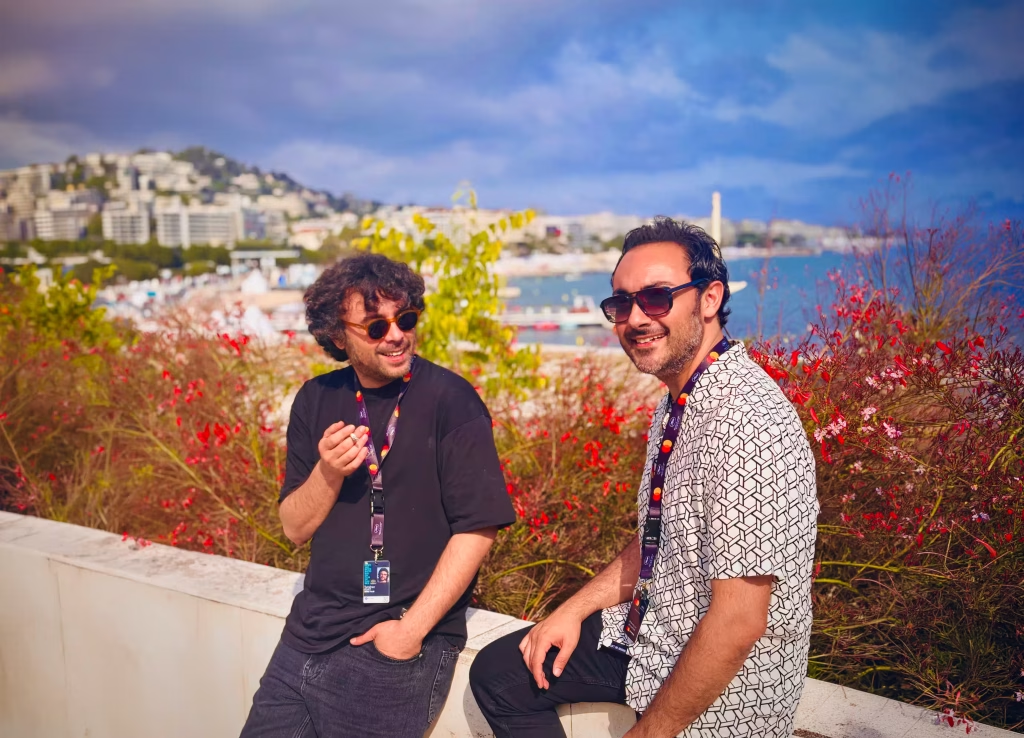
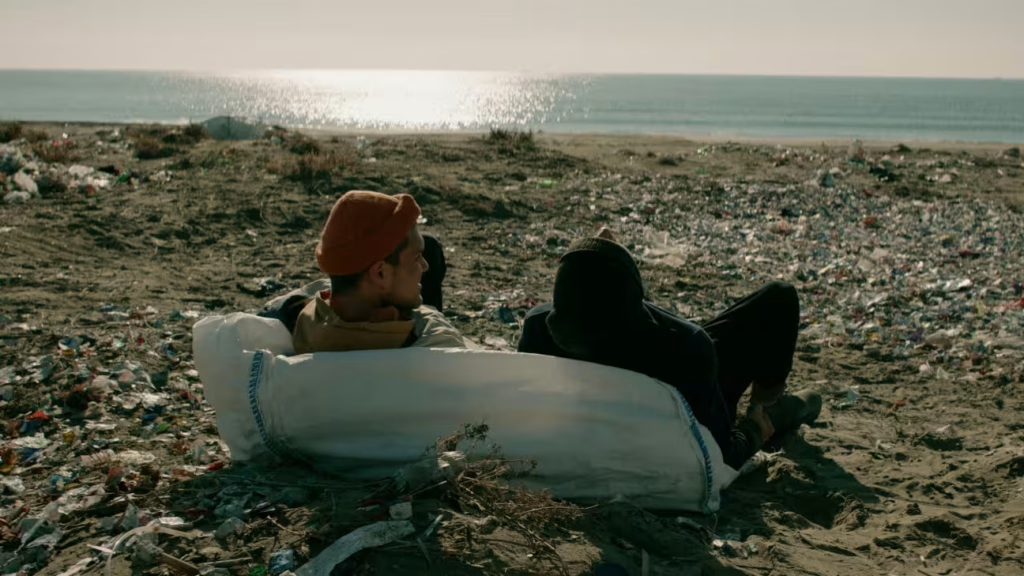
One of the unexpected outcomes of Meetings on the Bridge was that it led us to the Marché du Film in Cannes. We were invited to take part in the Goes to Cannes selection, organised in collaboration between the Istanbul Film Festival and Başka Sinema. Five projects from Türkiye were selected to be presented at the Cannes market, and honestly, going from trying to make a film in a landfill to presenting that film in Cannes just five months later was the kind of surreal experience that could only happen through cinema.
Even while we were still in post-production, the film had already begun to find its own path. At that stage, my priority was to bring an international co-producer on board. I wanted to strengthen the project’s international dimension and complete certain aspects of the film, particularly the sound design, through collaboration abroad. Meetings on the Bridge and Goes to Cannes provided the ideal environment for that.
However, after a series of conversations with potential partners, I realised that pursuing a co-production would significantly extend the timeline, and that gradually pushed me away from the idea. Around the same time, we received post-production support from the General Directorate of Cinema. At that point, my priority became simply finishing the film.
By then, I could already feel that the film was approaching completion. Rather than continuing to look for new support programmes, we began submitting to festivals, driven by the desire to finally share the film with audiences. SEYAP’s Festivals in Istanbul programme is an extraordinary initiative. By staying connected with the Meetings on the Bridge team and through the support of Festivals in Istanbul, we were able to get the film in front of festivals we had only dreamed of reaching.
While preparing for the pitching process in Cannes, what aspects of the project did you have to rethink in order to make it more marketable internationally? How did this process influence your creative decisions?
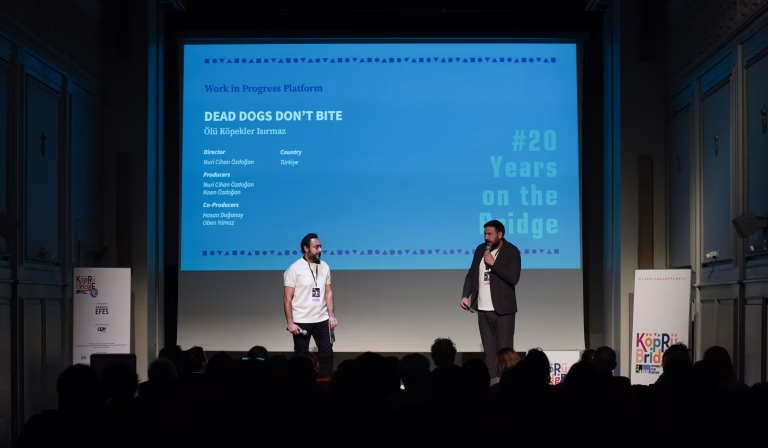
In those meetings and presentations, you tend to focus on two things: the story itself and the film’s production model.
When you’re telling the story and people start interrupting you with questions because they’re genuinely curious, that’s probably the best clue you can get. Pay attention to where those questions are coming from; that’s where the key lies. During Meetings on the Bridge, I noticed that the film’s layer involving the illegal waste trade attracted a great deal of interest. People would ask, “So there’s an illegal system making money from garbage?” or “Do these things actually happen in the city where you made the film?” At that moment, I thought: that’s it. Those questions made it very clear how we should talk about the film in Cannes.
As for the production model, if you’re developing your first feature, not having the backing of a public institution can become a significant disadvantage, especially within script development platforms. International producers and investors are usually looking for some kind of assurance that the film will actually get made.
A Work in Progress platform, however, is a different situation altogether. By that stage, you already have a film. The conversation becomes much more concrete. And the fact that an independent production has virtually unlimited flexibility can be highly attractive, both to international distributors and to potential co-production partners.

While developing your first feature film, was there anything during your first Cannes experience that made you think, “I wish we had been better prepared for this”? In your opinion, what is the thing that emerging producers most often overlook during this process?
One of the biggest advantages we had before going to Cannes was that Yamaç Okur, someone I deeply admire, gave Tunahan and me a crash course on how Cannes works. Thanks to that, I learned how to use Cinando and was able to start arranging meetings before we even arrived. Through Cinando, you can see who will be attending Cannes that year and access their contact information. The earlier you reach out to the people or companies you want to meet, the better, because schedules fill up very quickly.
When planning your meetings, don’t forget that the Marché du Film is also home to the sales companies, distributors, and production companies behind many of the films that made you fall in love with cinema in the first place. It’s still important to carry a brochure, a postcard, or some other physical material about your film. At the end of the day, people meet hundreds of others during Cannes, and sometimes a small detail is all it takes to be remembered.
Cannes is the kind of place where something interesting is happening at every moment. One minute you’re in a one-on-one meeting, and a few minutes later you find yourself at a panel discussion or listening to a great conversation. It’s worth checking the programme, but it’s also worth allowing yourself to go with the flow. Sometimes the most valuable connections aren’t made in scheduled meetings at all. They happen after a panel, while waiting for a talk to begin, or over a cup of coffee between events.
I’m certainly not experienced enough to be giving advice to young producers. Even now, I’m sure there are countless things I still overlook and mistakes I continue to make without realising it. But if I were to say one thing, it would be this: don’t go there empty-handed. Go with a film you’ve made, or a film you’re determined to make. Go prepared to convince the person across from you that you’ve been seriously working on your project. Because if you’re in Cannes, opportunities may not come looking for you, but you can always go looking for them.
What was the most fundamental difference you observed between the system at the Marché du Film and the way the industry operates in Türkiye? In your view, is the main thing missing in Türkiye funding, networks, or a culture of organisation?
Let me start with what’s in my heart, and then I’ll try to answer your question more rationally: the day cinema breaks free from its dependence on money, all the excess will fall away and only the essence will remain.
Anyway, we can come back to that later.
One thing became very clear to me during the journey of Dead Dogs Don’t Bite: the struggle of cinema to exist as an industry is not unique to Türkiye. In many parts of the world, being a filmmaker is an economic challenge. If you’re a filmmaker and occasionally catch yourself wondering whether you actually have a real job, trust me, you’re not alone. When you attend market-driven festivals like Cannes or Berlin and see that there is a living ecosystem for every kind of cinema, you realise that what you do is not only an artistic pursuit, but also a profession. So to my fellow filmmakers: relax. We can finally tell our parents, our spouses, and our friends that we do, in fact, have a real job.
Back when I was preparing to leave engineering, I spent a lot of time thinking about the economics of cinema. It seemed to me that an industry can only grow in two ways: either the work it produces finds buyers, or money from outside the industry starts flowing in.
While looking for financing for my screenplays, I eventually realised that I would have to find resources outside the film industry because I simply couldn’t find them within it. In a way, that’s exactly how Dead Dogs Don’t Bite was made. The resources we brought together through sponsors, supporters, and our own producers were, in fact, coming from outside the industry.
Of course, if we’re going to talk about sustainability, the work itself has to find an audience. The thing missing in Türkiye is not support for cinema. In fact, increasing support should not be the ultimate goal. Any industry that survives solely on support eventually becomes dependent on it. And when it comes to something like cinema, which exists in the uneasy space between art and industry, dependency makes it increasingly difficult to create freely and independently.
The goal should be to make films without needing support. The goal should be for films to be watched. The goal should be to build a culture that genuinely values cinema and the experience of watching films.
We have to accept that filmmaking today cannot be separated from economics. At the same time, we should never forget how delicate the balance between the two really is. Once the relationship between cinema and capital turns into a form of submission, the soul of the work inevitably begins to suffer. When economic concerns dominate and people become afraid to take risks, what emerges is no longer a work of art. It becomes a product. And products tend to look a lot like one another.
Money matters only when it serves imagination. It can support imagination, but it can never replace it. It can buy comfort, but it can’t buy conviction.
I believe in the justice of cinema. No matter how much money you spend, the screen has a way of exposing emotions you don’t genuinely feel and stories you don’t truly believe in. It throws them right back at you. Cinema has too much character to spend its life trying to please spoiled owners of capital. It is too powerful to surrender completely to economics.
Anyone who believes money alone can make a great film is fooling themselves. Anyone who thinks everything can be bought is missing the point entirely. As I said at the beginning, they may become part of the residue, but they’ll never be part of the essence.
Coming from Adana rather than Istanbul, the traditional centre of the Turkish film industry, was this a disadvantage throughout your journey, or did it provide a greater sense of freedom? In practical terms, how did it shape your production process and the decisions you made along the way?
Adana is a city of cinema. People here are deeply in love with films and with art. When I had no funding in place and was saying, “We’re making this film anyway,” it was Adana that gave me the courage to believe that was possible.
This city has never let us down, not since our very first short films. We know where the stories are. We know where those stories can be transformed into cinematic images. And we know who we can make them with. If you know how to connect with people in Adana, there is almost no door that will remain closed to you. That’s why, in Adana, almost anything feels possible.
What we’re chasing here are good stories. Not just our own stories, but any story we believe has the potential to become a good film. We’ll get involved at the screenplay stage, help assemble a crew, or quietly tell a first-time director how to communicate with an actor. The title attached to our name is rarely important. Most of the time, it doesn’t even matter whether our name is mentioned at all.
Being part of a meaningful story and helping someone find their way into cinema is enough for us. We do it for cinema, and nothing else. We couldn’t care less about anyone’s ego.
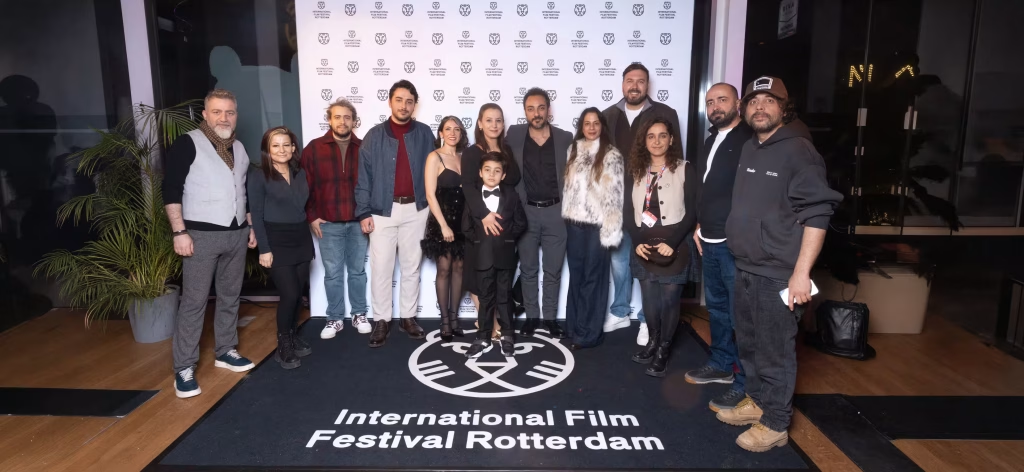
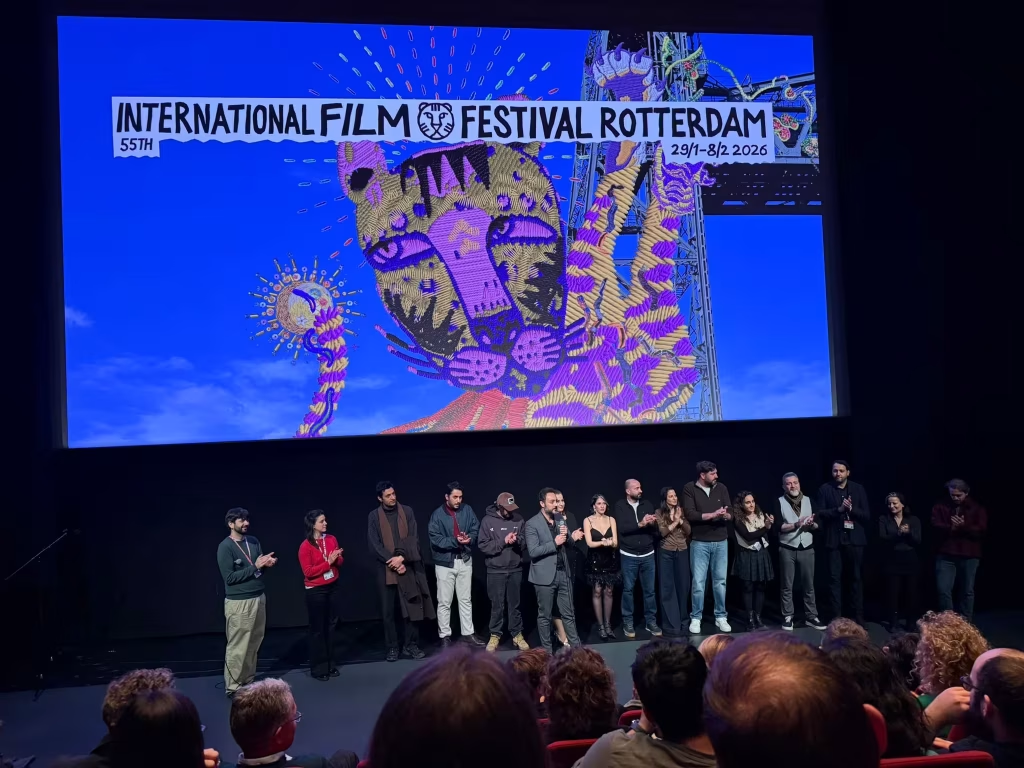
After Dead Dogs Don’t Bite was selected for the Bright Future section in Rotterdam, what kind of momentum began to build around the film? In practical terms, what changed in terms of distribution, sales opportunities, or future projects? Could you share some specific examples?
Although the International Film Festival Rotterdam is not primarily a market-driven festival, it holds a remarkably respected position within the international film industry. I think a large part of that reputation comes from the fact that the festival has remained committed to its vision for so many years without compromising it.
The Bright Future section, in particular, is dedicated to discovering bold and innovative voices, and people know that this programme consistently brings surprising films to the forefront. Once our film was announced on the festival’s website, we began receiving emails from international festivals and distributors. People were curious about the film, and that was an exciting feeling.
Suddenly, we found ourselves in a situation where, on the one hand, we were preparing for our screenings in Rotterdam, while on the other, we were having numerous conversations about the film’s distribution and future journey. It was the first time we truly felt that the film had begun to create its own momentum internationally.
Looking back today, would you follow the same path if you were starting from scratch, or are there lessons you took away from making your first feature that will lead you to approach your next project differently?
If you’re a filmmaker who has spent years chasing the dream of making a first feature, you inevitably begin imagining every detail of it, right down to the design of the screenplay’s cover page. You spend years trying to create the ideal conditions, believing that once everything is in place, you’ll finally be able to make the film you dream of.
The truth is that today, simply making a film, let alone making a good one, is already something close to a miracle. When I stepped onto the set of Dead Dogs Don’t Bite, I knew I was chasing a miracle, and I knew that doing so would require me to let go of many of the dreams I had carried for years. I was fully aware that the resources available to me were not the resources I had spent so long trying to secure.
The moment you decide to make a film, millions of reasons will appear telling you not to. But in the end, you only need one reason to make it: cinema itself.
And with all of these experiences behind me, I can say this with complete sincerity: if I were starting over today, I would have made my first feature years earlier, the very first time a funding body rejected one of my projects. I wouldn’t have waited a second longer.
P.S. This is definitely not advice.

Bir Cevap Yazın