

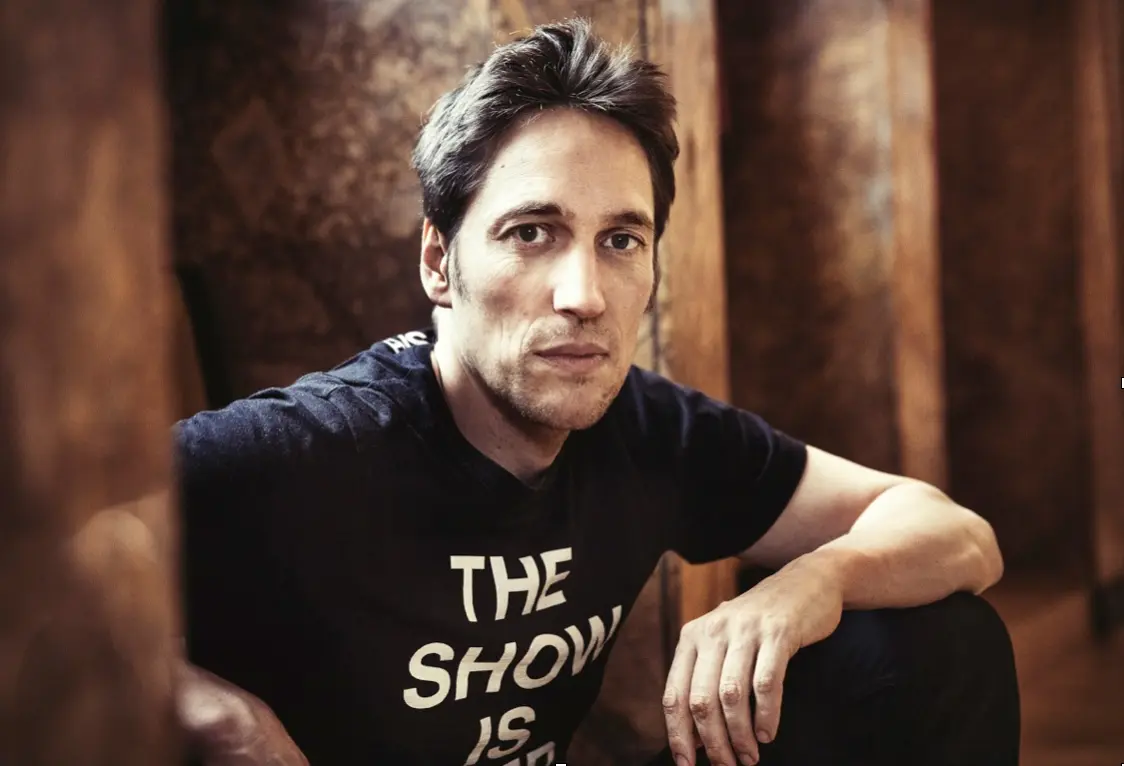
A cake factory, domestic conflicts, migration, belonging, national identity, and an absurd love story… These elements, which might seem difficult to reconcile at first glance, come together in an extraordinary harmony in The Cake Dynasty, the debut feature film by Danish playwright and director Christian Lollike. Initially penned for the stage, the story was adapted for the screen years later, transforming into a work that scrutinizes not only the transformation of a family business but also the ongoing debates on identity, culture, and coexistence in contemporary Europe.
Producing across theatre, opera, performance art, and cinema, Lollike does not use satire merely to entertain, but to render visible the contradictions and tensions embedded within society.
As part of the International Gastronomy Film Festival, we spoke with director Christian Lollike about the genesis of The Cake Dynasty, the relationship between food and identity, the power of dark humor, and the role art can assume in an increasingly polarized world.
TR | EN | Türkçe versiyona buradan ulaşabilirsiniz.
Çiğdem Beder: The Cake Dynasty tells a highly absurd story while also reflecting familiar tensions within contemporary Europe. Economic concerns, environmental transformation, cultural conflicts, and love all converge in the film. What was the starting point for this story, and how did you develop such a multi-layered narrative?
Christian Lollike: In most of my writing, I begin by exploring things in contemporary culture that provokes me. I began writing The Cake Dynasty as a play in 2013, more than ten years ago. Back then––and not much have changed in that regard really––the Danish public was obsessed with mainly two things: immigrants and refugees from Muslim countries and personal fitness. I wanted to explore the intersection between these two very different phenomena in a satire. That was the starting point for the writing process.
Çiğdem Beder: The cake factory at the center of the film almost feels like a character in its own right. What does this setting represent for you, and what role does it play within the story?
Christian Lollike: I’m glad to hear that the factory feels like a character in the film. In the writing and directing process, I considered it a metaphor for Denmark as well as a character. It’s an arena for the playing out of relations between members of the family business, meaning different generations; between employers and employees; between old and new Danes. Today, the workplace plays such a fundamental role in our lives as both the setting in which we realize ourselves and our dreams and our heritage and our identities but also where we exploit the dreams, heritages, and identities of others.
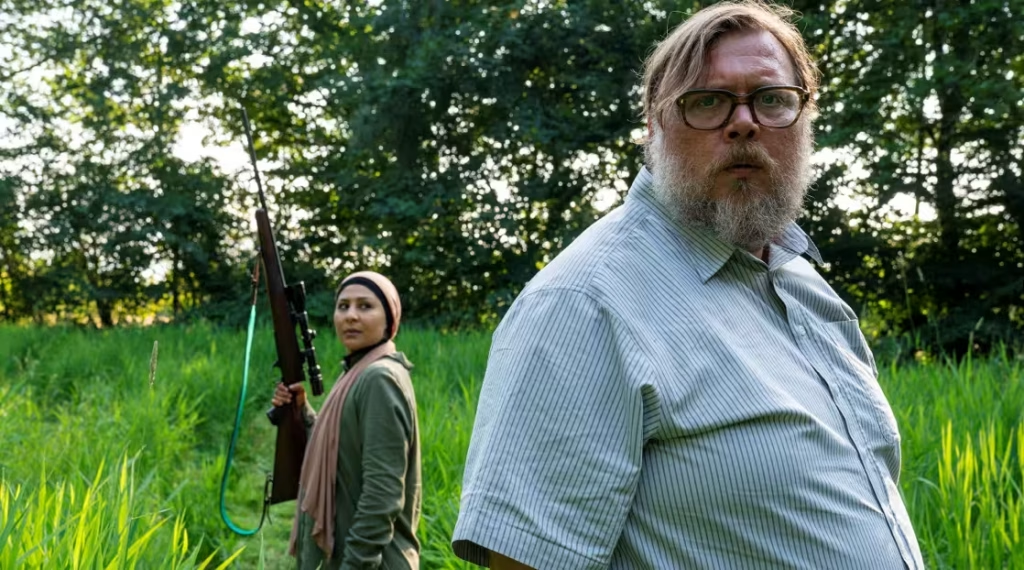
In The Cake Dynasty, food is not merely a necessity or a visual element; it serves as a central storytelling device. Today, gastronomy is deeply intertwined with discussions around sustainability, migration, identity, and class. Why do you think food carries such powerful meaning, both in storytelling and in society?
It is no accident that the factory of The Cake Dynasty produces cakes and cookies. As in many other cultures, in Denmark, cake is a vehicle for national identity. Cake is closely connected to the way in which we perceive ourselves––as laidback, easy-going, nice people. So, when foreign cakes are introduced to the table, it creates a tension.
In Denmark, we have a term called “hygge,” meaning coziness or something like that, which we use for most enjoyable ways of spending the time, often including something sweet. Moreover, hygge has become a brand used to evoke our identity and attract tourists. For me, The Cake Dynasty is an exploration of the powerful meaning that cake and hygge carries in Danish society, but––and more poignantly so––a satire on the contradictions inherent in this meaning-making process. Contradictions between national identity and global culture; between laidback hygge and frenetic personal training and obsessions with health; between self-image and branding value or culture and business.
Tragic events and comic moments constantly intertwine throughout The Cake Dynasty. What role do you think dark humor plays in helping audiences engage with difficult subjects?
For me, comedy and tragedy do not need to be separated as genres. I guess it is because I like for movies and other types of art to be “ahead of me” when I’m in the audience. I don’t want to know where the plot is going, I want art to be unpredictable and surprising. That’s one side of it. Another is the Danish tradition for poking fun at the most serious topics. For instance, we are renowned––and infamous––for the so-called Muhammad cartoons controversy back in 2005, revealing our national difficulties in adapting to a more globalized culture. The satire of The Cake Dynasty is very different from the cartoons, but I guess the film connects to a certain naïve Danish way of approaching things we don’t understand. To not show a darkness in that would not feel culturally accurate.
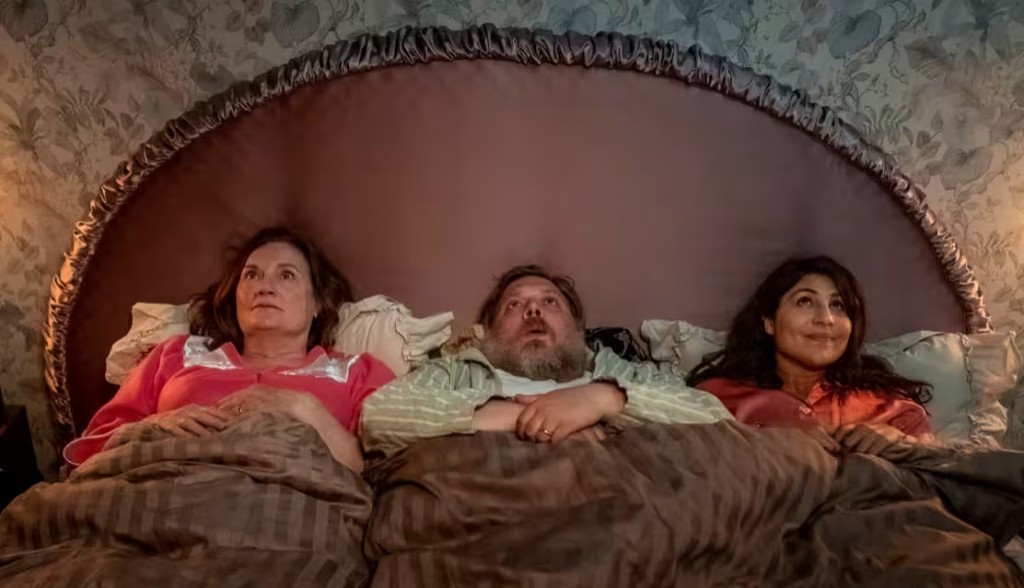
Your characters are often defined by their flaws, contradictions, and vulnerabilities. How do you balance understanding a character with being critical of them?
I try to write characters that surprise myself as I’m writing them. As a satire, The Cake Dynasty started out with characters that were meant to represent certain currents in contemporary culture. This satirical approach, however, carried the danger of rendering the characters flat. But then I started imbuing them with characteristics you would never find in the reservoir of well-known stereotypes. And then I started working with actors who were extremely generous in their willingness to defend their characters in every way. I’m very thankful for that.
You first wrote this story as a stage play and adapted it into a film years later. Did your perspective on the story—or the way you wanted to tell it—change over time?
When I wrote the stage play in 2013, there was much less public sensitivity about the themes it addressed. When I adapted the play to a movie script, it felt more acute to create nuance to the story and credibility to the characters and work with actors to create more emotional depth to them. I think this has to do with the changing of medium to film as well. In many ways, film requires some degree of anchorage in realism as opposed to theatre. On stage, you can set up a different game.

You have worked across different mediums, including theatre, film, and opera. How do you decide which form is best suited for a particular idea?
Again, I think film necessitates some degree of realism, at least as a starting point. I chose to adapt The Cake Dynasty to film because it works with characters and plot in a more direct way than many of my other plays. Usually, I let the content decide the medium. I need to feel provoked to explore something in society, in the culture, and then figure out how to address it best and most surprisingly. Often, however, it’s not the obvious choice of medium that works best. You need some tension between content and medium to create something truly surprising.
You have previously spoken about being influenced by David Bowie’s use of different identities and personas. When you write, do you find yourself moving between different voices or perspectives as well?
Definitely. Much of my writing begins as a dialogue with myself. Often, it’s just a fragment of schizophrenic arguing with myself about a topic, an observation, or a feeling. It’s become a method for me to start the scriptwriting process. It results in a self-reflexivity that brings you beyond yourself in a good way.
Discussions around identity, belonging, and cultural difference have become increasingly polarized in recent years. How do you think art should engage with these issues?
They certainly have. And it is of utmost importance that art and film continue to deal with these issues when nationalisms rise and curiosity towards the foreign and the other dwindles. With polarization as its backdrop, I believe that art should provoke meetings and confrontations between different cultures and identities. In fact, the next film I hope to make explores these issues in a narrative that moves between the Danish and the Turkish context.

Festivals such as the International Gastronomy Film Festival bring cinema and food to the same table. In your view, what is it that connects these two worlds so naturally?
Food is part of the social fabric that inspires filmmaking: tradition and heritage, identity and belonging, economy and agriculture, inequality and exploitation. It serves as an endless reservoir for storytelling about human interaction. I’m glad that the International Gastronomy Film Festival included The Cake Dynasty as part of its programme to show an example of how satire on identity and cultural difference can be built on the gastronomical world of pastry.

Bir Cevap Yazın